ReadNovaX Blog
Why 2026 Is the Golden Age of Online Storytelling | Trends, Platforms & Insights
Explore why 2026 is the golden age of online storytelling. From web novels and interactive fiction to creator monetization and reader communities — discover what is changing and why it matters.
By ReadNovaX Team · Published 11 Jun 2026 · Last Updated 26 Jul 2026 · 14 min read

Why 2026 Is the Golden Age of Online Storytelling
Trends, Platforms, and the Reader Revolution Reshaping Digital Narratives
Here is a number that most people in publishing do not talk about openly: Wattpad alone has crossed 90 million users. Royal Road sees hundreds of thousands of daily active readers. Webnovel hosts titles with reader counts that rival mid-tier traditionally published bestsellers. And none of these numbers existed in any meaningful form fifteen years ago.
That is not a slow evolution. That is a structural shift in how stories are written, distributed, and consumed.
What is happening in online storytelling right now is not simply about more people reading online. It is about a fundamental change in the relationship between writers and readers. The gap that once separated a creator from their audience — one that required agents, publishers, marketing budgets, and distribution networks — has largely closed. A writer with a compelling story and a consistent publishing schedule can now build a loyal readership from scratch, in any country, without asking anyone's permission.
That is why observers, analysts, and creators across the industry are describing online storytelling 2026 as something close to a golden age. The infrastructure is ready. The audiences are there. And the formats that work best — serialized chapters, community-driven narratives, multimedia storytelling — are maturing fast.
This guide breaks down exactly what is driving that momentum, which platforms are leading it, and what writers and readers can expect as these trends continue to accelerate.

It is easy to say that storytelling has gone digital. That has been true for over a decade. What is different in 2026 is not the medium. It is the ecosystem around the medium.
Traditional publishing was built around scarcity. Physical shelf space was limited. Print runs were expensive. Publisher resources were finite. The gatekeeping that defined the industry was partly commercial and partly practical — there genuinely was not room for everyone.
Digital platforms removed the scarcity. They did not remove the need for quality, but they eliminated the bottleneck between a writer finishing a chapter and a reader finding it. That shift sounds simple, but its downstream effects are enormous.
Key Shift In traditional publishing, reader feedback arrives after a book is finished, printed, and sold. In online storytelling, it arrives within hours of posting a chapter. This changes how writers develop stories and how readers experience them. |
|---|
Beyond feedback speed, the community dynamic is entirely different. Readers on serialized fiction platforms are not passive consumers. They leave chapter-by-chapter reactions, build fan theories in comment threads, create fan art, and sometimes maintain the conversation around a story for years. That level of engagement is structurally impossible in traditional publishing.
Traditional Publishing vs. Online Storytelling — Key Differences
Factor | Traditional Publishing | Online Storytelling |
|---|---|---|
Publishing route | Requires agent/publisher | Publish directly to readers |
Reader feedback | Months or years after launch | Within hours of each chapter |
Story length control | Fixed by contract | Grows at your own pace |
Audience reach | Regional/national | Global from day one |
Income model | Advance + royalties | Subscriptions, coins, Patreon |
Community building | Limited/managed by publisher | Built directly with readers |
Format flexibility | Print or ebook only | Text, audio, visuals combined |

Understanding the growth of online storytelling requires looking at where that storytelling is actually happening. The major platforms have each developed distinct identities, audiences, and monetization models — and knowing the difference matters if you are a writer choosing where to build.
Major Online Storytelling Platforms — 2026 Overview
Platform | Best Known For | Monetization / Model |
|---|---|---|
Wattpad | Teen/YA, romance, fan fiction | 90M+ users, free with paid tier |
Royal Road | LitRPG, progression, fantasy | Free, strong community ratings |
Webnovel | Eastern-style fantasy, cultivation | Coin/subscription model |
ScribbleHub | Indie fiction, all genres | Free, author-driven, no gatekeeping |
Tapas | Comics + prose, serialized episodes | Ink currency, creator monetization |
AO3 | Fan fiction, transformative works | Non-profit, community-moderated |
What all of them share, though, is the infrastructure for direct creator-reader relationships. Comment threads, ratings systems, reader libraries, follow notifications — these features are not accessories. They are the mechanism through which online storytelling builds and retains audiences.
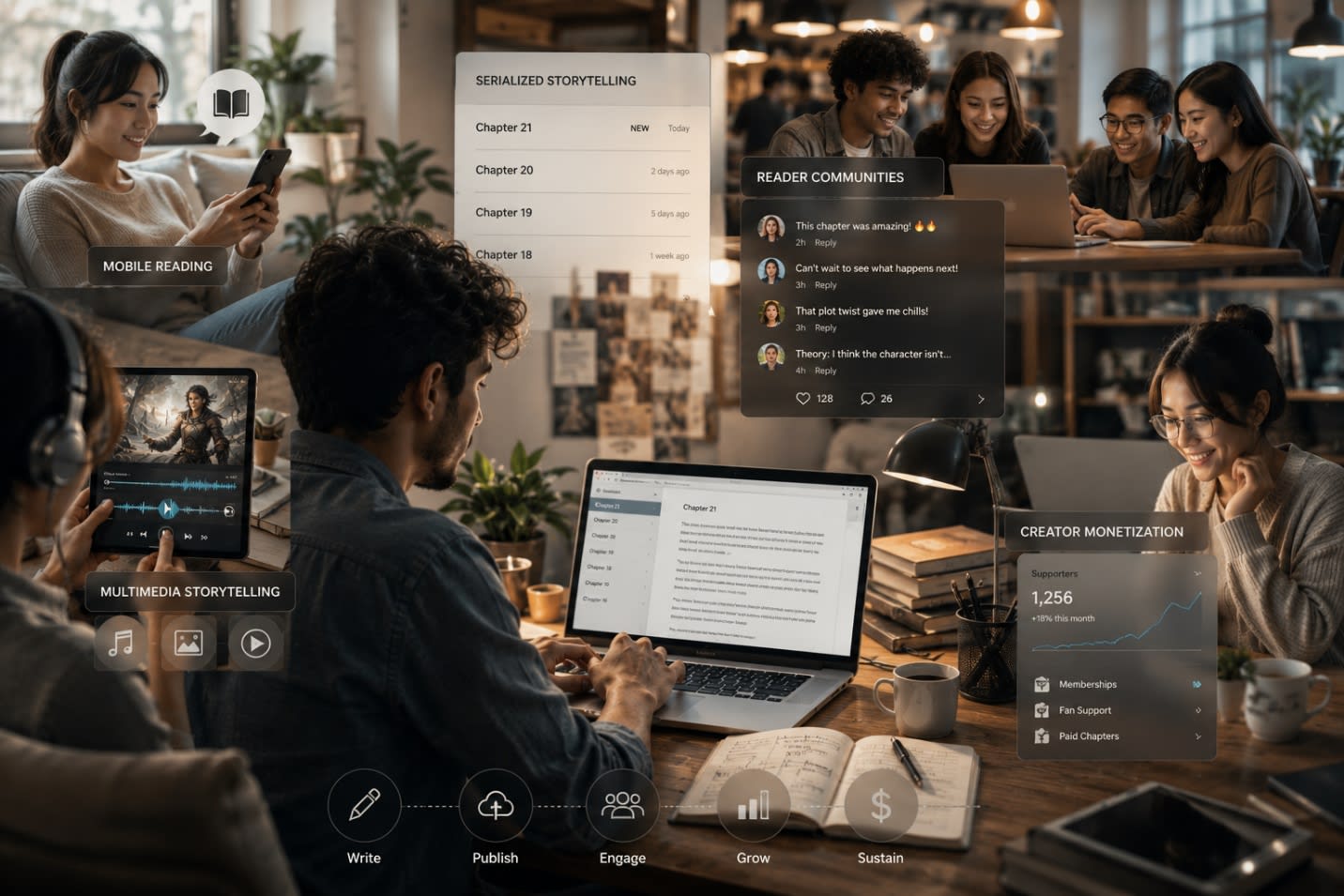
Several forces are coming together right now in ways that are unlike any previous moment in digital publishing. Each of these trends is significant on its own. Together, they explain why 2026 feels different.
1. Serialized Web Novels Have Become the Dominant Format
The single biggest structural shift in online storytelling is the rise of the serialized web novel. Rather than releasing a complete story, writers post chapters on a regular schedule — sometimes daily, sometimes weekly — and readers follow the story as it develops in real time.
This model works for several interconnected reasons. Regular posting creates habitual reading behavior. Readers who check a platform for a new chapter three times a week are far more engaged than someone who buys a book and reads it once. That habit-formation is enormously valuable for both platform retention and writer audience growth.
It also lowers the barrier to entry for readers. Starting a 400,000-word fantasy epic feels daunting. Reading the first chapter of an ongoing story feels manageable. Serialization lets readers sample without commitment, then deepens the investment gradually.
2. Reader Communities Are Now Part of the Story
On the most active serialized fiction platforms, the comment thread beneath a chapter is not an afterthought. It is a living extension of the narrative itself. Readers analyze foreshadowing, debate character motivations, predict future plot developments, and occasionally catch continuity errors before the writer does.
This collective engagement creates something that does not exist in traditional publishing: a shared, evolving interpretation of a story that develops alongside the story itself. Some writers have credited reader theories with sparking plot directions they had not originally planned. Others have used community reactions to identify which characters resonate most, allowing them to develop those relationships more deeply in subsequent chapters.
The result is a form of storytelling that is still author-driven but genuinely shaped by the presence of an active audience. That dynamic is new. It is one of the defining characteristics of online storytelling in 2026.
3. Mobile-First Reading Has Reshaped Story Structure
The overwhelming majority of readers on platforms like Wattpad and Webnovel access stories on their phones. That single fact has had significant structural effects on how stories are written.
Chapter lengths have shifted. Sentence density has changed. Scene pacing has accelerated. Writers who understand the mobile reading context — short chapters with strong hooks and chapter-ending beats that compel the reader to tap 'next' — consistently outperform writers who approach digital serialization with the pacing conventions of print fiction.
This is not a criticism of longer, denser writing. It is a recognition that medium shapes form. The writers who are growing the fastest in online storytelling are those who have internalized the reading environment their audience is actually using.
4. Multimedia Integration Is Expanding What a Story Can Be
Text-only storytelling is no longer the only option on most major platforms. Tapas built its model around combining comics and prose. Wattpad has integrated audio storytelling features. Fan communities on platforms like AO3 spawn original illustrations, podfics, and video essays that extend the life of a story well beyond its final chapter.
This expansion is not replacing written narrative. It is enriching it. A writer who publishes a chapter and then shares a character mood board, a chapter soundtrack, or a fan-art commission creates multiple touchpoints with their audience. Each one deepens the reader's connection to the story world.
For new writers, this represents an opportunity. The storytellers who are building the most engaged communities in 2026 are often those treating their story as a world rather than a document.
5. Creator Monetization Has Become Viable at Smaller Scale
For most of the history of online storytelling, the path to income required either massive scale or a traditional publishing deal. That has changed meaningfully.
Webnovel's coin system, Tapas's ink currency, Wattpad's paid stories program, and the widespread use of Patreon and Ko-fi by serialized fiction writers have created income streams that did not exist five years ago. A writer with 5,000 dedicated readers can now generate meaningful income through a combination of platform monetization and direct reader support.
This viability at smaller scale matters enormously for the ecosystem. It means that mid-tier creators — writers with dedicated niche audiences who would never have been commercially viable in traditional publishing — can now sustain their work. That sustainability creates more content, which deepens platform ecosystems, which attracts more readers.
No conversation about digital storytelling in 2026 is complete without addressing AI — and no conversation about AI in storytelling is useful without being specific about what it actually does and does not do.
AI writing tools have become widely available. Some writers use them. Most of the writers building the strongest, most loyal reader communities do not rely on them in any central way. There is a reason for that.
Where AI tools have found genuine utility is in the non-creative logistics of writing at volume: research organization, continuity tracking, brainstorming when stuck, and outlining complex plot arcs. These are legitimate uses that can help a writer maintain a demanding publishing schedule without sacrificing quality.
The future of storytelling in the context of AI is not replacement. It is a division of labor where technology handles the administrative weight of sustained creative output, and human writers continue to do the thing that readers are actually paying for: making them feel something real.
Growth brings problems. The expansion of online storytelling has created several challenges that any writer or reader operating in this space needs to understand clearly.
Discoverability Is Harder Than It Looks
Every major platform now hosts more stories than any reader could consume in multiple lifetimes. The discoverability problem is real. A well-written story with no audience is invisible on a platform with millions of titles.
Reader Retention Requires More Than a Good Opening
Attracting a first-time reader is one challenge. Keeping them through a 200,000-word serialized story is another. Retention in online storytelling depends on consistent quality across the entire run, not just strong early chapters.
The writers with the best retention rates tend to be those who understand pacing at both the chapter level and the arc level. Each chapter needs to end with enough momentum to pull a reader to the next one. Each arc needs to resolve satisfyingly before opening a new one. That structural discipline is what separates writers with loyal multi-year readerships from those who build initial interest and then lose it.
Platform Dependency Is a Real Risk
Many writers have built their entire audience on a single platform. When platforms change their algorithms, update their monetization policies, or restructure their recommendation systems, those writers absorb the impact directly.
The writers managing this risk most effectively are building off-platform relationships in parallel. A mailing list, a Discord server, a Patreon — these create direct connections with readers that survive platform changes. The goal is not to leave the platform. It is to not be entirely dependent on it.
Before launching or growing a serialized story in the current environment, consider whether you have addressed each of the following:
The trends driving the golden age of online storytelling are not slowing down. Several developments are likely to define the next phase of growth.
Deeper Personalization at the Platform Level
Recommendation systems are becoming significantly more sophisticated. The platforms investing in better discovery tools are seeing measurable improvements in reader engagement and time on platform. As these systems mature, readers will find stories that match their specific tastes with much greater accuracy — which benefits niche writers who would previously have struggled to find their audience.
Interactive Narrative Formats
Choose-your-own-adventure formats have existed for decades, but the technical infrastructure for genuinely sophisticated interactive storytelling is only now becoming accessible at scale. Platforms are beginning to experiment with branching narratives, reader-vote story direction features, and collaborative world-building tools. These formats are still early, but the investment is real.
Audio and Voice as a Native Format
Podcast fiction has maintained a dedicated following for years. Several major platforms are now building native audio features rather than treating audio as a secondary format. The intersection of serialized fiction and audio storytelling is one of the most interesting spaces in online narrative right now.
Regional Language Markets Opening Up
English has dominated online storytelling platforms, but that is changing. Korean web fiction, Chinese xuanhuan and xianxia, Japanese light novels, and Spanish-language serialized fiction are all growing rapidly — both on dedicated regional platforms and through translation communities on global platforms. The global reach of online storytelling is becoming genuinely global in a way that was only partial before.

The golden age of online storytelling is not a prediction. It is a description of conditions that already exist.
Writers have more direct access to readers than at any previous point in publishing history. Readers have more content, more community, and more ways to engage with stories they love than ever before. The platforms connecting them are more sophisticated, more stable, and more monetizable than they were five years ago.
What makes 2026 a turning point is not any single development. It is the convergence — serialized formats that suit modern reading habits, communities that deepen engagement beyond the story itself, monetization models that make sustained creativity viable, and a global infrastructure that removes geography from the equation.
If you are a writer, the conditions for building a meaningful readership have never been better. If you are a reader, the variety and depth of available stories has never been greater. And if you are simply watching this space evolve, the next five years will be more interesting than the last ten.
The story of how stories are told has always been one of the most interesting stories around. Right now, it is a genuinely good one.
Frequently Asked Questions
Why is 2026 specifically considered a turning point for online storytelling?
Several trends that have been building for years are converging simultaneously in 2026. Serialized web novels have reached mainstream scale. Platform monetization tools have matured enough to support mid-tier creators. Mobile reading habits are now deeply established. And global reader communities have grown large enough to sustain stories in niche genres that would have struggled to find an audience even five years ago. It is the combination of these factors — not any single one — that makes this moment different.
What is the biggest mistake new writers make when starting on online storytelling platforms?
Treating the first chapter as an introduction rather than a hook. On serialized platforms, reader acquisition happens almost entirely through opening chapters and story descriptions. A first chapter that spends its opening pages on world-building exposition, backstory, or scene-setting before anything happens will lose the majority of prospective readers before the story has had a chance to demonstrate what makes it worth following. The most successful new writers on these platforms open in the middle of something — a conflict, a mystery, a character decision with stakes — and establish the story's core promise within the first few paragraphs.
Will AI replace human writers in online storytelling?
No — and the dynamics of serialized fiction make this particularly clear. Readers of long-running serialized stories develop an intimate familiarity with a writer's specific voice, phrasing, and narrative instincts. When that voice changes or flattens, the community notices quickly and the reaction is typically negative. AI tools can help writers manage the logistical demands of high-volume output — research, continuity tracking, outlining — but the human qualities that make readers loyal to a specific writer are not replicable by current or foreseeable AI systems. The writers building the most durable audiences in 2026 are doing so on the strength of distinctly human creative voices.