ReadNovaX Blog
How Interactive Web Novels Turn Readers Into Part of the Story
Want to write stories that readers help shape? This guide explains the real mechanics behind interactive Web novel writing — from managing reader choices to avoiding plot collapse — with practical, experience-based advice you can actually use.
By ReadNovaX Team · Published 28 May 2026 · Last Updated 26 Jul 2026 · 11 min read

There’s a moment almost every fiction writer experiences eventually.
You spend weeks — sometimes months — building a story you genuinely care about. You edit late into the night, publish the first chapters with nervous excitement, and wait for readers to arrive.
A few people click.
Maybe one or two leave a like.
Then the silence starts.
No discussions. No theories. No returning readers checking for updates. The story exists, but it feels disconnected from the people reading it.
Now compare that to a different kind of publishing experience.
An author uploads a chapter that ends with a difficult decision. At the bottom, readers are asked to vote between two possible paths. By morning, the comment section is overflowing with arguments, predictions, alliances, and emotional reactions. Readers aren’t just consuming the story anymore — they’re participating in it.
That difference changes everything.
This is the real power behind interactive Web novel writing. And despite how often the term gets treated like a trend or gimmick, the psychology behind it is very real. When readers feel involved in shaping a story, they stop behaving like passive consumers and start behaving like a community.
Done correctly, interactive storytelling creates stronger retention, deeper emotional investment, and far more consistent engagement than traditional serialized fiction.
But it only works if the system behind the story is designed carefully.
Otherwise, interactive fiction turns into chaos surprisingly fast.
Why Passive Reading Is Losing Ground
Reader behavior has changed dramatically over the last decade.
People no longer experience entertainment quietly. Modern internet culture is built around participation. Readers react publicly, post theories, debate character decisions, clip emotional scenes, and build entire communities around shared speculation.
That mindset naturally affects fiction too.
Especially younger audiences who grew up surrounded by livestream chats, multiplayer games, reaction content, and social platforms don’t just want to observe stories from a distance anymore. They want interaction. They want acknowledgment. They want the feeling that their presence matters.
This doesn’t mean readers want to become the author.
Most readers absolutely do not want complete control over a story.
What they want is influence.
There’s an important difference between those two things.
Traditional novels are static experiences. The story is finished long before the reader arrives. Nothing they think, predict, or feel can affect the text itself.
Serialized Web novels work differently.
Because chapters release gradually, the audience exists alongside the writing process. Readers react in real time. Authors see those reactions immediately. That creates something traditional publishing can’t replicate: mutual awareness between writer and audience.
That feeling alone changes reader attachment levels dramatically.
The actual choices and polls are only part of the appeal.
The deeper appeal is psychological.
Readers stay because the story feels alive.
Build the Participation System Before Chapter One
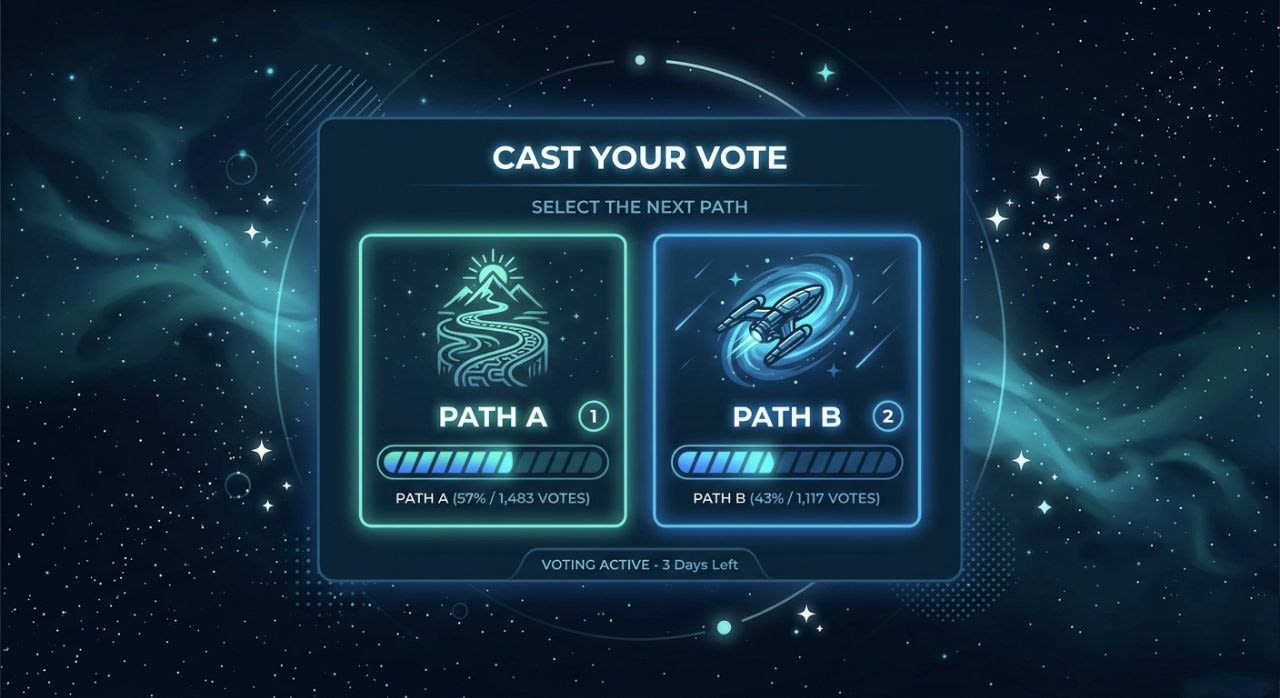
Most interactive fiction doesn’t fail because the writing is bad.
It fails because the structure behind the interaction was never planned properly.
A common mistake looks like this:
The author uploads a chapter.
At the end, they ask:
“What should happen next?”
The comments explode with completely different ideas.
The author gets overwhelmed trying to satisfy everyone, loses narrative direction, and eventually stops updating altogether.
Interactive storytelling without boundaries becomes unsustainable very quickly.
That’s why the participation system needs to exist before readers ever arrive.
Decide What Readers Can Actually Influence
Readers need clarity from the beginning.
Can they influence:
- Main plot decisions?
- Character relationships?
- Side character survival?
- Tone and atmosphere?
- Moral outcomes?
- World-building details?
There’s no universally correct approach here.
Some authors allow readers to shape almost everything. Others only let readers influence smaller branching moments while protecting the main storyline.
Both approaches can work.
The important part is consistency.
If readers believe their choices matter but later discover the outcomes were mostly cosmetic, trust disappears fast.
Clear rules prevent resentment.
Use Structured Choices Instead of Open Chaos

Open-ended questions create noise.
Structured options create direction.
Instead of asking:
“What should happen next?”
Try:
- Should the protagonist trust the stranger?
- Should they escape immediately?
- Should they investigate the hidden room first?
Now readers are participating inside boundaries you already prepared for.
This protects both the story and the writer.
You never want to offer choices you aren’t emotionally or structurally prepared to write.
The safest interactive fiction model usually involves:
- 2–4 meaningful options,
- clear consequences,
- fixed voting windows,
- and pre-planned outcomes.
Readers still feel agency.
But you maintain narrative control.
That balance matters more than most new interactive authors realize.
Consistency Matters More Than Speed
One of the biggest mistakes Web novel writers make is prioritizing upload frequency over reliability.
Interactive fiction especially needs breathing room.
You need time to:
- read comments,
- analyze reactions,
- prepare alternate paths,
- and plan convergence points carefully.
Trying to maintain daily uploads while also managing interactive systems usually leads to burnout.
Predictable schedules work better.
For example:
- Tuesday → New chapter
- Thursday → Voting closes
- Saturday → Outcome chapter releases
Once readers understand the rhythm, participation becomes part of their weekly routine.
That routine strengthens community retention more than raw upload volume ever will.
The Real Problem With Branching Stories
Here’s the issue nobody warns new writers about:
Every meaningful choice creates another version of the story.
And if those branches keep expanding forever, the workload becomes impossible.
This is called combinatorial explosion.
It’s the reason many ambitious interactive stories quietly disappear after a dozen chapters.
Writers accidentally create eight different novels at the same time.
That model is not sustainable for a solo creator.
The Funnel Structure That Saves Interactive Stories
The smartest interactive fiction writers solve this problem using convergence design.
Some writers call it:
- bottleneck plotting,
- funnel structure,
- or branch convergence.
The concept is simple:
Readers can temporarily split the story into different directions, but eventually those paths reconnect at important narrative milestones.
Think about rivers splitting into smaller streams before eventually flowing back into the same larger current.
That’s how sustainable interactive storytelling works.
For example:
- Chapter 7 ends with a major vote
- Readers choose between escape or confrontation
- Chapter 8A and 8B play out very differently
- But Chapter 9 reconnects both paths into the same central crisis
The reader experience still feels meaningful because the emotional journey changed.
But the author avoids building endless parallel timelines.
This single structural decision prevents more abandoned interactive projects than almost anything else.
Why Interactive Stories Create Stronger Reader Loyalty
The retention mechanics behind interactive fiction are deeply psychological.
The moment a reader votes on a decision, they invest emotionally in the outcome.
Now they care differently.
They aren’t just wondering what happens next anymore.
They’re wondering whether their choice was correct.
That subtle shift increases return rates dramatically.
Behavioral psychology explains this through:
- emotional investment,
- commitment bias,
- and sunk-cost attachment.
But in practical terms, it simply means readers feel connected to the story in a more personal way.
That connection gets even stronger when authors acknowledge reader participation directly.
Simple actions matter:
- replying to comments,
- referencing theories,
- highlighting predictions,
- remembering active community members.
These moments prove the audience is actually being seen.
And readers rarely forget that feeling.
One Powerful Strategy Most Authors Ignore
There’s one technique that creates extremely loyal readers when used carefully:
Theory Canonization
This happens when a reader correctly predicts a future development based on clues you intentionally planted.
Instead of ignoring the prediction, you allow it to become official story canon and acknowledge the reader publicly.
That moment feels enormous to the community.
Because suddenly the audience realizes:
“This author genuinely pays attention.”
Readers begin analyzing chapters more deeply after that.
Discussion quality improves.
Speculation becomes part of the entertainment itself.
And the reader whose theory became canon often turns into one of your strongest long-term supporters.
Not because you rewarded them artificially.
Because you validated their investment.
Your Comment Section Is Part of the Writing Process
Interactive fiction authors should stop treating comments like background noise.
Your comment section is actually live audience research.
Patterns matter more than individual opinions.
If large numbers of readers:
- distrust a character,
- become emotionally attached to someone unexpected,
- complain about pacing,
- or seem confused by certain plot points,
that information is valuable.
You can use audience expectations strategically.
Sometimes you confirm them.
Sometimes you deliberately subvert them.
Both approaches become stronger when you understand what readers currently believe.
The emotional temperature of your audience matters too.
If readers feel exhausted after several intense chapters, slowing the pace slightly often improves long-term engagement.
If they seem restless during slower sections, raising stakes earlier may help retention.
This doesn’t mean readers control your story.
You are still the author.
But the best interactive writers learn how to listen without surrendering direction.
That distinction matters enormously.
Platform Choice Can Quietly Kill Interactive Fiction
A lot of authors underestimate how much platform design affects community storytelling.
Some Web novel platforms heavily reward raw upload speed.
Their algorithms prioritize:
- daily uploads,
- extremely high chapter counts,
- and constant activity.
That environment often conflicts directly with interactive fiction.
Interactive storytelling requires slower pacing behind the scenes because planning reader choices properly takes time.
There’s another issue too:
Paywalls create participation friction.
If readers need to unlock chapters before voting or discussing outcomes, engagement naturally drops.
Interactive fiction depends on low-friction community interaction.
That’s why open-access environments often perform better for this format.
The easier it is for readers to:
- comment,
- speculate,
- vote,
- and share theories,
the stronger the community becomes.
When choosing where to publish, don’t just think about exposure.
Think about connection.
Because interactive storytelling lives inside the relationship between author and audience.
Not just inside the chapters themselves.
A Practical Launch Plan for Your First Interactive Web Novel
You do not need your entire story fully mapped before publishing.
But you do need a stable foundation.
Start With Immediate Stakes
Avoid spending thousands of words explaining lore before readers care about the protagonist.
Interactive fiction works best when readers emotionally engage quickly.
Start inside movement:
- danger,
- conflict,
- pressure,
- uncertainty,
- or moral tension.
Then end the opening chapter with a meaningful decision.
Readers should immediately feel:
“My choice changes something.”
Explain the Rules Clearly
Your audience should understand:
- what they can influence,
- how voting works,
- when votes close,
- and what kinds of choices are off-limits.
This isn’t unnecessary formality.
It builds trust.
Readers participate more confidently when the system feels stable.
Write Multiple Outcomes Early
Before posting your first poll, prepare both outcomes in advance.
This removes panic after voting closes.
It also forces you to evaluate whether both options are genuinely interesting before offering them publicly.
Weak choices create weak engagement.
Highlight Readers From Day One
Community culture forms surprisingly early.
Feature readers consistently:
- mention good theories,
- highlight funny reactions,
- acknowledge insightful observations,
- or pin strong comments.
Readers who feel noticed early often become the most active long-term supporters of the story.
And active readers attract more active readers.
The Difficult Reality Most Guides Don’t Mention
Interactive fiction is rewarding.
But it is not easier than traditional storytelling.
In many ways, it’s harder.
You are managing:
- narrative structure,
- audience psychology,
- community expectations,
- pacing,
- and reader relationships simultaneously.
Some votes will go against your preferred direction.
Some readers will dislike outcomes loudly.
Some people will feel disappointed no matter what you choose.
That friction is unavoidable.
The authors who succeed long-term are usually the ones who handle disagreement honestly instead of defensively.
Readers can tolerate unpopular decisions surprisingly well when they trust the author behind them.
That trust becomes the foundation of the entire experience.
And that’s ultimately what interactive fiction is really about.
Not gimmicks.
Not polls.
Not engagement hacks.
Trust.
Readers trust that their presence matters.
Authors trust readers enough to invite participation without losing creative control.
When that balance works, interactive storytelling becomes something traditional fiction can never fully replicate.
Not just a story people consume.
A story people belong to.
Ready to begin?
Start with a dilemma.
Set the rules clearly.
Write both paths before opening the vote.
And treat your comment section like part of the story itself.
Because for the readers who truly connect with your world, it will be.
Frequently Asked Questions
What is an interactive Web novel?
An interactive Web novel is a type of online serialized story where readers can influence certain parts of the narrative through votes, choices, polls, or community decisions. Unlike traditional novels, interactive fiction allows readers to participate in how the story develops while the author still controls the overall direction.
Is interactive storytelling good for reader engagement?
Yes. Interactive storytelling significantly improves reader engagement because readers feel emotionally invested in the outcome. Voting on choices, discussing theories, and influencing events creates a stronger connection between the audience and the story compared to passive reading.
How do Web novel authors avoid plot chaos in branching stories?
Most experienced authors use a funnel or convergence structure. This means story branches temporarily split into different paths before reconnecting at major plot points. It allows readers to experience meaningful choices without forcing the author to maintain endless parallel storylines.
Can beginner writers create interactive stories?
Yes. Beginner writers can absolutely create interactive stories if they start with a simple structure. The best approach is to limit choices early, prepare multiple outcomes in advance, and focus on maintaining consistent updates rather than creating overly complex branching systems.
How many choices should readers get in an interactive story?
Most successful interactive Web novels use two to four meaningful choices at a time. Too many options overwhelm readers and create unnecessary complexity for the writer. Smaller, carefully designed decisions usually produce stronger engagement.
Are interactive Web novels harder to write than traditional novels?
In many ways, yes. Interactive fiction requires writers to manage storytelling, community engagement, pacing, reader psychology, and branching structures simultaneously. However, it also creates deeper audience loyalty and stronger long-term engagement.
How can authors encourage more comments and community participation?
Authors can increase engagement by: ending chapters with meaningful dilemmas, responding to reader theories, acknowledging active community members, using polls consistently, and creating situations readers naturally want to debate. Community interaction grows when readers feel their presence matters.