ReadNovaX Blog
How to Write a Webnovel First Chapter
Learn how to write a webnovel first chapter that hooks readers from word one. Covers the 1,500-word blueprint, mobile formatting, genre strategies, and the cliffhanger loop that converts browsers into subscribers.
By ReadNovaX Team · Published 26 Jun 2026 · Last Updated 26 Jul 2026 · 27 min read
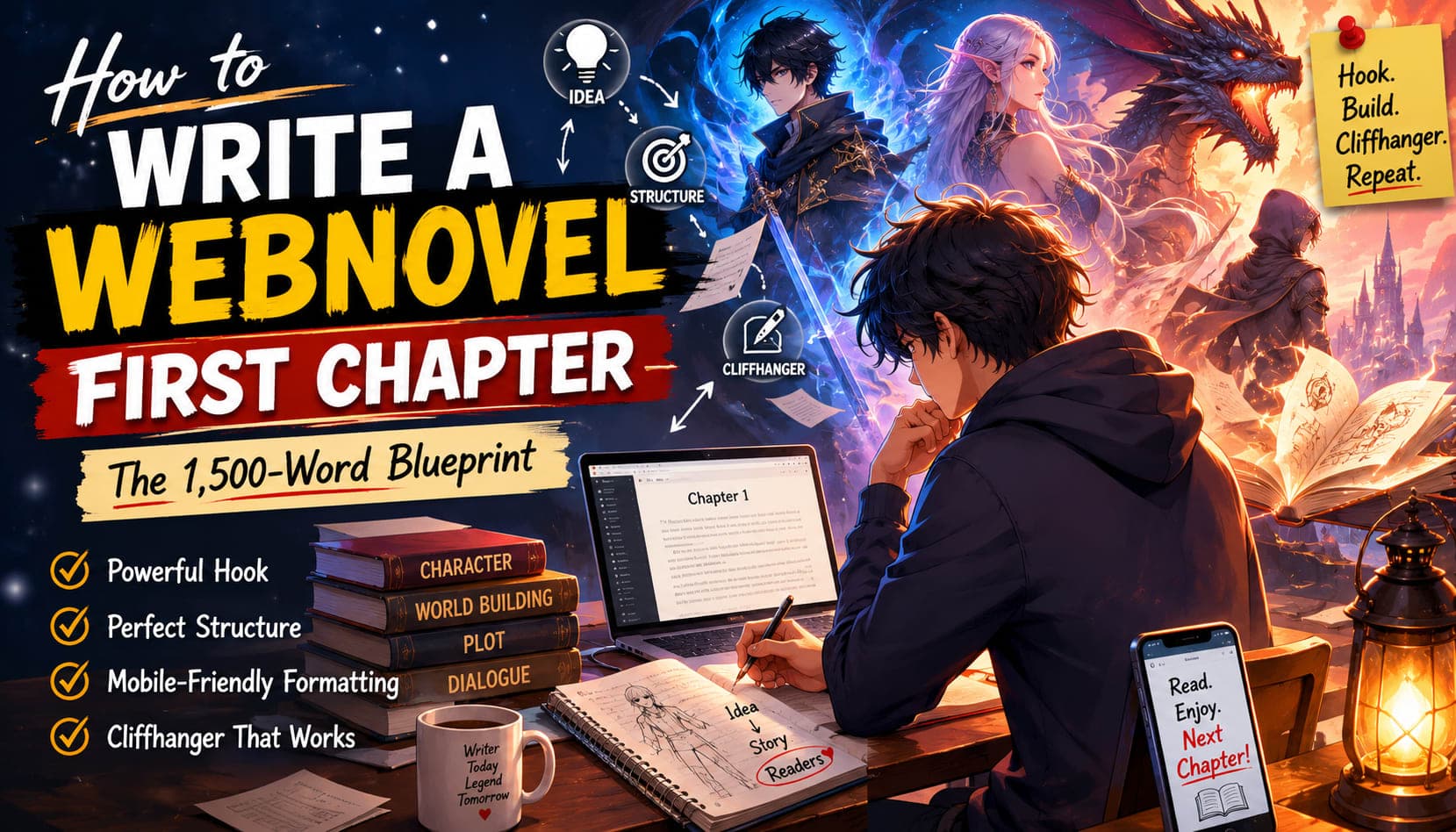
How to Write a Webnovel First Chapter: The 1,500-Word Blueprint That Keeps Readers Hooked
Most webnovel readers make a decision within the first three scrolls. Not three chapters. Three scrolls — the distance a thumb travels on a phone screen in about eight seconds.
That's the operating reality for anyone writing serialized fiction in 2026. The question of how to write a webnovel first chapter is really a question about how to write one that survives contact with a reader who is choosing between your story and twelve others that loaded while yours was buffering.
I've reviewed hundreds of serialized fiction openings across Webnovel, Royal Road, and independent platforms. The patterns separating the stories that built genuine subscriber bases from the ones that died in obscurity after chapter three are consistent. They're learnable. And most of them have nothing to do with prose quality — they have everything to do with structure, pacing, and the specific mechanics of serialized chapter 1 architecture.
This guide covers the complete webnovel first chapter structure, a field-tested 1,500-word blueprint, genre-specific strategies, mobile formatting rules, and the psychological principles behind reader retention. If you've been staring at a blank opening scene, or you've written and rewritten your Chapter 1 and still can't figure out why readers aren't continuing, you're in the right place.
Who This Guide Is For
This guide is written for writers who are serious about building a readership through serialized fiction. Specifically:
- First-time webnovel writers who have a story idea but don't know how to open it effectively
- Authors moving from traditional fiction who keep hearing their Chapter 1 feels 'slow'
- Writers restarting an older series with a new understanding of serial pacing
- LitRPG and Progression Fantasy authors who struggle to introduce systems without front-loading exposition
- Romance, Romantasy, and Cozy Fantasy writers who want emotional pull from page one
- Any creator who has watched their first-to-second chapter retention drop and can't identify why
The techniques here are platform-agnostic, but they're calibrated for the specific behavior of online serial fiction readers — a different audience from literary fiction readers, with different habits and much lower patience for delayed gratification.
Why Your First Chapter Matters More Than Any Other Chapter
Chapter 1 is not just an opening. In serialized fiction, it's a conversion event. A reader who finishes your first chapter and continues to chapter two has already undergone a fundamental change in their relationship with your story — they're no longer browsing, they're invested.
That shift from browser to reader to subscriber is everything. And it happens, or doesn't happen, inside chapter 1.
Here's what's actually at stake in your opening chapter:
First Impressions in Serialized Fiction Are Permanent
Traditional novel readers often give a book fifty pages before deciding. Webnovel readers give you a chapter — and in most cases, the first five hundred words of that chapter. There are no second chances disguised as 'slow burn openings.' The reader who bounces is gone.
Reader Retention Compounds
Every additional chapter a reader completes increases the statistical likelihood they'll subscribe and continue indefinitely. Getting a reader from Chapter 1 to Chapter 3 is dramatically harder than getting them from Chapter 3 to Chapter 30. Your opening chapter is therefore the single highest-leverage piece of writing in your entire series.
Subscriber Conversion Happens Early
Most readers who eventually become long-term subscribers make that decision within the first reading session. A strong Chapter 1 that flows directly into a compelling Chapter 2 produces that first-session binge behavior that turns casual browsers into followers of a series.
Story Velocity Signals Quality
In serialized fiction, story velocity — the perceived speed at which meaningful things happen — is a quality signal. Readers equate narrative momentum with authorial competence. A chapter that establishes conflict, character, and stakes within its word count reads as confident. A chapter that meanders through backstory reads as amateur, regardless of actual prose quality.
Traditional Novel vs Webnovel: Why the Rules Have Changed
Writers who come to webnovels from traditional fiction — or from a diet of traditional publishing advice — frequently carry habits that actively hurt their serial openings. The rules are different because the medium is different.
Traditional Novel Opening | Webnovel Chapter 1 |
|---|---|
Slow atmospheric build acceptable | Immediate conflict required |
Long descriptive paragraphs | 2–3 line mobile-spaced paragraphs |
Backstory woven into early chapters | Curiosity established before context |
Reader bought the book (already invested) | Reader chose your story from a list (not yet invested) |
Bookstore or library discovery | Algorithm-driven smartphone discovery |
50-page tolerance for slow openings | 5-scroll tolerance maximum |
Character interiority can delay action | Character voice must appear immediately |
World depth signals literary ambition | World teasing signals narrative intelligence |
The shift from bookstore to smartphone changes every assumption. A bookstore reader picked up your book, read the back cover, maybe the first page, and carried it to the register. They arrived at page one having already decided to give it a chance.
A webnovel reader found your title in a genre listing, tapped it, and started reading — while three other tabs were already loading. The decision to continue is being made in real time, on a small screen, with no prior investment. That's the environment your Chapter 1 has to win.
The Mobile Reading Trap: Why Most Chapter 1s Fail
There's a specific failure mode that kills otherwise well-written webnovel openings, and it's almost always invisible to the writer. It looks like this on the writer's screen: three beautifully crafted paragraphs of 6–8 sentences each, establishing a rich fantasy world with careful attention to atmosphere.
It looks like this on a reader's phone: an unbroken grey wall of text that requires scrolling before a single piece of dialogue or action appears.
That's the mobile reading trap. And it doesn't matter how good the prose is underneath.
The 3-Second Scroll Rule
When a reader arrives at your chapter on a smartphone, they scroll before they read. It's a behavioral habit — a quick visual scan to assess whether the text is approachable before committing to reading it linearly. If the first visible screen shows no white space, no dialogue, and no scene-breaking paragraph rhythm, a significant portion of readers never actually start reading. They leave.
The 3-Second Scroll Rule is simple: the first visual impression of your chapter — before a single word is read — must look readable. White space, short paragraphs, and early dialogue are not stylistic choices in webnovels. They are functional requirements of the format.
Bad Opening vs Better Opening BAD: "The Kingdom of Aethermoor had stood for seven centuries, its ancient walls bearing witness to the rise and fall of three dynasties, each more powerful than the last. The great stone towers that had once housed the legendary Order of the Sunspear now stood empty, their banners faded and torn by decades of wind and neglect. It was into this world — fractured, desperate, and on the cusp of a new age of darkness — that Kael was born, the third son of a minor lord in the eastern provinces, his destiny as yet unwritten..." BETTER: "The execution was scheduled for dawn. Kael had four hours to decide whether to stop it." The second version creates immediate conflict, a ticking clock, stakes, and a character with agency — in eighteen words. Everything else can wait. |
|---|
The Psychology Behind Reader Retention
Understanding why readers continue — or don't — is the most practical tool a serial fiction writer can have. The mechanics of reader retention aren't mysterious. They're rooted in well-documented psychological patterns.
The Curiosity Gap
Readers continue reading to close a gap between what they know and what they want to know. Your Chapter 1 needs to open multiple curiosity gaps — questions embedded in the narrative that readers feel compelled to see answered. These can be about character (who is this person really?), world (what exactly is that system?), or plot (what happens after that choice?).
The Zeigarnik Effect
Psychologically, people remember and feel more tension around unfinished tasks than completed ones. In fiction terms: an unresolved scene is cognitively stickier than a resolved one. A chapter that ends mid-conflict, mid-revelation, or mid-decision exploits the Zeigarnik Effect naturally — readers feel an almost physical pull toward the next chapter.
Emotional Investment and the Dopamine Loop
Serialized fiction that builds long-term readership runs on emotional investment. Readers don't binge because the plot is interesting. They binge because they feel something about a character, and they need to know that character is okay, or wins, or gets what they want. The faster you create emotional investment — not necessarily through drama, but through character specificity and voice — the earlier the dopamine loop activates.
Open Loops and Narrative Momentum
Every unanswered question in a chapter is an open loop. Open loops create forward momentum. The most effective serial fiction writers are disciplined about closing some loops per chapter (giving readers satisfaction) while opening new ones simultaneously (giving readers a reason to continue). Chapter 1's job is to open enough loops that Chapter 2 becomes inevitable.
The Complete 1,500-Word Webnovel First Chapter Blueprint
Featured Snippet Answer: How Long Should a Webnovel First Chapter Be? A webnovel first chapter should be between 1,200 and 1,800 words, with 1,500 words as the practical target. This length is long enough to establish conflict, introduce the protagonist, hint at the world, and end with a cliffhanger — and short enough to read comfortably on a smartphone in 6–8 minutes. Chapters shorter than 1,000 words often feel incomplete; chapters longer than 2,500 words increase the reading friction that causes first-chapter abandonment. |
|---|
Blueprint Section | Word Range | Primary Goal | Reader State at End |
|---|---|---|---|
Phase 1: The Hook | Words 1–300 | Create immediate disruption | Curious, slightly disoriented |
Phase 2: Character | Words 301–700 | Build emotional investment | Attached to the protagonist |
Phase 3: World | Words 701–1,200 | Reveal context naturally | Oriented, wanting more |
Phase 4: Cliffhanger | Words 1,201–1,500 | Force Chapter 2 | Urgently clicking Next |
Phase 1 | Words 1–300: The Immediate Disruption
Your opening 300 words have one job: make a reader feel that something has already happened, or is about to happen, that cannot be ignored. This is not about action in the cinematic sense — it's about narrative tension, which can exist in dialogue, in a character's internal realization, in a single line of environmental detail that implies danger.
What to do in Phase 1:
- Open in the middle of a situation, not at the beginning of backstory
- Introduce conflict or disruption within the first paragraph
- Establish a specific character voice, not a generic narrator
- Create at least one curiosity gap before word 150
- Avoid: weather descriptions, waking up from dreams, 'My name is X and I live in...' constructions
Phase 1 Example WEAK HOOK: "My name is Rin. I was sixteen years old when I first heard the Voice. That was before I knew what the Voice meant, or what it would cost me to listen to it." STRONG HOOK: "The Voice spoke for the first time the morning of my sister's execution. It told me exactly how to stop it. It didn't tell me I wouldn't want to." Both are first-person. Both introduce a Voice as a central element. The second creates three immediate curiosity gaps — what execution, how does the Voice know how to stop it, and what does 'wouldn't want to' mean — in 27 words. |
|---|
Phase 2 | Words 301–700: Building a Character Readers Care About
Once you've created enough tension to hold a reader's attention, Phase 2 is about transferring emotional investment from the situation to the person inside it. Readers follow characters, not plots. The fastest way to build emotional investment is not tragedy or sympathy — it's specificity.
A character who thinks in specific ways, uses specific language, and has specific contradictions (wants one thing, fears another) feels real much faster than a character described with generic attributes. Show us the gap between who they appear to be and who they actually are.
What to do in Phase 2:
- Reveal a concrete goal — what does this person want right now?
- Show a flaw, not through description but through behavior or thought
- Use the character's voice to filter their world (how they see things tells us who they are)
- Embed backstory through choice and action, not summary
- Avoid: character sheets disguised as narration ('I was tall, with dark hair and unusual golden eyes')
Phase 3 | Words 701–1,200: Reveal the World Without Info Dumping
This is where the majority of first chapters break. Writers know their world in extraordinary detail, and they feel an urgent need to share it. Readers, at this stage, don't have the emotional investment to absorb large amounts of contextual information.
The rule is simple: readers will accept world information in direct proportion to how emotionally invested they already are. If you've built sufficient investment in Phase 2, a moderate amount of world context lands in Phase 3. If you haven't, any context feels like a lecture.
Techniques for natural world revelation:
- Environmental storytelling: show the world's rules through specific details in the scene, not explanations
- Dialogue-embedded context: characters reference the world naturally because they live in it
- For LitRPG: introduce one system element actively (a notification, a prompt, a first skill) rather than frontloading a full interface
- For Transmigration/Isekai: the protagonist's disorientation is the vehicle — what they notice, what confuses them, what scares them
- Avoid: passages that begin with 'In this world...' or 'The magic system worked by...'
Phase 4 | Words 1,201–1,500: The Serialized Cliffhanger Loop
The last 300 words of your chapter have one mechanical purpose: make Chapter 2 feel unavoidable. This is not optional. Every serialized chapter that builds a readership ends with an open loop strong enough to pull the reader forward.
Three types of effective Chapter 1 endings:
- The decision cliffhanger: the protagonist is forced to make a choice at the end of the chapter, and we cut before we see the outcome
- The revelation cliffhanger: something is revealed in the final lines that recontextualizes everything we've read — a twist, a confirmation of fear, an unexpected arrival
- The emotional cliffhanger: a relationship or emotional situation reaches a peak, and the reader needs to know what happens next for reasons of character, not plot
Example Chapter 1 Endings DECISION: "The gate would close in ten seconds. Elara looked at her brother's face — the fear in it, the trust in it — and made the only choice she could live with. She turned and ran toward the fire." REVELATION: "The message had no sender. The timestamp read three days from now. The last line read: I know you found this. Don't come to the archive. — You" EMOTIONAL: "He'd said he would be there. He'd promised, in the way that people promise when they mean it. The chair across from her was empty. It had been empty for an hour. She finally understood he wasn't coming, and the thing she felt wasn't sadness. It was relief. That was the part she couldn't explain to anyone." |
|---|
How to Write a Webnovel First Chapter Without Info Dumping
Info dumping is the single most common reason capable writers lose readers in Chapter 1. It's not a plot problem or a character problem — it's a sequencing problem. The information exists. The world detail is real. The mistake is delivering it before readers have a reason to want it.
The core principle: readers enjoy discovering a world. They don't enjoy being briefed on it.
Info Dump (What Not to Do) | Natural Revelation (What to Do Instead) |
|---|---|
"Aethermoor had three types of mages: Flamecallers, Stormweavers, and Voidwalkers. Flamecallers could..." | "The Voidwalker across the square noticed her staring and smiled — slow, deliberate. Rin had only ever seen one before, and that one had burned a village to ash." |
"In the year 2187, humanity had colonized four planets..." | "The transport to New Ceres left at 0400. She'd sold two months of water rations to afford the ticket." |
"The System had appeared three years ago, granting humans skills, levels, and classes..." | "[Skill Acquired: Minor Detect Life] She stared at the notification. Three years of hunting, and this was the first time she'd ever triggered one." |
The right-hand column delivers the same information as the left. The reader understands there are mage types, a colonized universe, and a System. But they understand it through scene and implication rather than explanation. That distinction is everything.
Info Dumping Checklist
- Does any paragraph contain more than two pieces of world information not connected to an immediate action or emotion?
- Does the protagonist explain their world to themselves in ways they already know? (Characters don't narrate facts they understand — that narration is for the reader, and readers know it)
- Is any history or backstory delivered before the reader has a reason to care about the present?
If yes to any of these: cut, restructure, and embed through action.
Genre-Specific Chapter 1 Strategies
The 1,500-word blueprint applies across genres, but how each phase looks depends significantly on what genre you're writing. Here's how to calibrate your opening by genre.
LitRPG
LitRPG readers want to see the System, but they don't want a system manual as an opening chapter. The single most effective LitRPG Chapter 1 approach is: introduce the protagonist before the interface, show the first interaction with the System as a plot event (not a feature demonstration), and end with a status prompt that raises a question rather than answering one.
- Introduce one skill, notification, or interface element — not a full status screen
- Make the System's arrival or first activation feel like a narrative moment, not a tutorial
- The protagonist's reaction to the System reveals character — use that reaction deliberately
- Reserve attribute tables and full skill listings for Chapter 2 or 3 when readers are already invested
Progression Fantasy
Progression Fantasy readers are motivated by the promise of growth. Chapter 1 needs to establish two things clearly: who the protagonist is now, and why ascending from that position is meaningful. The gap between current status and potential is the hook.
- Establish the starting point with specificity — a concrete weakness, limitation, or underdog position
- Hint at the awakening, cultivation breakthrough, or power activation without delivering it immediately
- Show what the protagonist wants to become and why it matters to them personally
- The cliffhanger should directly relate to the first step of their ascent
Transmigration and Isekai
The transmigration trope has a structural advantage: the protagonist's confusion and disorientation mirrors the reader's. You can reveal world details through what the protagonist notices and doesn't understand, which creates natural information delivery without exposition.
- The protagonist's first moments in the new world should be chaotic and sensory — physical, confusing, immediate
- Identity confusion is a hook: who am I now, what do I remember, what happened?
- Reveal the target world gradually through the transmigrated character's observations
- Avoid front-loading memories of the previous life — let the character (and reader) arrive in the new world first
Romantasy and Romance
Romance webnovel readers arrive looking for emotional chemistry. The first chapter doesn't necessarily require the romantic lead to appear, but it does require the protagonist to feel like someone worth falling for — or someone whose specific emotional wound makes the eventual relationship meaningful.
- Establish the protagonist's emotional state and what they're lacking before introducing the love interest
- If the romantic lead appears in Chapter 1, the first interaction should create tension — not instant attraction, but friction, implication, or a charged moment
- The hook is emotional, not plot-based: readers need to feel something within the first 300 words
- Avoid making the protagonist entirely passive — readers want a character who has agency, even in romance
Cozy Fantasy
Cozy Fantasy operates differently from other webnovel genres. The hook is atmosphere and warmth rather than conflict and tension. But that doesn't mean the opening can be static — something still needs to change in Chapter 1, even if that change is small and gentle.
- Establish the world's specific sensory texture immediately — light, smell, sound, temperature
- Introduce a character who feels like someone you'd want to spend time with, not someone in crisis
- The 'disruption' can be small: an unexpected visitor, a new opportunity, a discovered mystery
- Emotional safety is the genre promise — the opening should feel like a comfortable place to return to
Three Fatal Mistakes That Kill Reader Retention
Mistake 1: The History Lesson
This is the most common Chapter 1 failure, and it usually comes from a place of genuine enthusiasm. The writer has built a rich world and wants readers to understand it. So the chapter opens with paragraphs of context — kingdoms, histories, power systems, timelines — before introducing a character in a scene.
Readers don't care about history they haven't earned. The moment readers feel like they're attending a lecture rather than experiencing a story, reading friction spikes and they leave. History belongs in Chapter 3, when readers are so invested in the protagonist that they actively want context to understand what's happening to them.
Mistake 2: The Passive Main Character
A protagonist who observes, reflects, or waits for things to happen in Chapter 1 signals a story where things happen to the main character rather than one where the main character makes things happen. Readers follow decisions, not observations.
Passivity is different from internal conflict. A character who is terrified but chooses to act anyway is not passive. A character who watches events unfold and thinks about them is. Even if your story requires a slow burn setup, find the first decision your protagonist makes in the story and begin there.
Mistake 3: Desktop Formatting
A chapter formatted for a desktop document viewer — dense blocks of 8-sentence paragraphs, no dialogue spacing, no scene rhythm — reads very differently on a smartphone. What looks like 'proper prose formatting' on a word processor becomes visual punishment on a 6-inch screen.
The formatting is the experience. If readers have to work to extract meaning from a visually dense chapter, they stop working and move to the next story. Formatting is not a stylistic choice in webnovels. It is a functional component of reader retention.
Smartphone Formatting Rules
Mobile-first formatting isn't about dumbing down your prose. It's about making excellent prose legible in the environment where readers actually read it. These rules are non-negotiable for webnovel chapter 1 success in 2026.
Formatting Element | Desktop Fiction | Webnovel Mobile Standard |
|---|---|---|
Paragraph length | 5–8 sentences standard | 2–3 lines maximum per paragraph |
Dialogue | Embedded in paragraph blocks | New paragraph for every speaker |
Scene transitions | Line breaks or asterisks | Centered *** or line break with extra space |
Exposition blocks | Acceptable in longer form | Break up; never more than 3 lines uninterrupted |
Action sequences | Can be dense | Short, punchy sentences; each action its own beat |
Character thought | Italics in long blocks | Italicize, keep to 1–2 lines max |
Apply this as a practical test: paste your Chapter 1 into a notes app on your phone. Read it as a reader, not a writer. Where do you scroll without actually reading? That's where your formatting is losing people.
Chapter 1 Self-Editing Checklist (20 Points)
Before you publish your first chapter, run it through this checklist. Every 'No' is a revision opportunity.
Hook and Opening 1. Does conflict, disruption, or tension appear within the first 300 words? 2. Is the first paragraph something a reader would screenshot and share? 3. Does the opening avoid: dreams, waking up, weather descriptions, and 'my name is' constructions? 4. Is there at least one curiosity gap within the first 150 words? 5. Does the first line function as its own hook? |
|---|
Character 6. Does the protagonist have a specific voice — language and thought patterns that belong to them? 7. Is there a concrete goal or want visible within the first 700 words? 8. Does the character make at least one active decision in Chapter 1? 9. Is the flaw visible through behavior rather than description? 10. Could a reader describe who this protagonist is without quoting your 'character description' passages? |
|---|
World and Information 11. Is world information delivered through action, dialogue, or sensory detail rather than explanation? 12. Does any paragraph contain more than two pieces of world context not connected to an immediate scene event? 13. Can a new reader understand what's happening without a glossary? 14. Have you avoided 'In this world...' and 'Magic works by...' constructions? |
|---|
Pacing and Format 15. Are paragraphs 2–3 lines maximum when viewed on a smartphone? 16. Does every line of dialogue have its own paragraph? 17. Does every scene beat advance either character knowledge or plot — no decorative description? 18. Is reading friction zero — could a tired reader follow this comfortably at 11pm? |
|---|
Ending and Continuation 19. Does the chapter end with an open loop — a decision, revelation, or emotional moment left unresolved? 20. After finishing the chapter, does reading Chapter 2 feel necessary rather than optional? |
|---|
Strong Hook Examples by Genre
Study these not to imitate them directly, but to understand the specific techniques they use in their opening lines.
Fantasy
Hook Example — Fantasy "They hanged my brother at dawn. By noon, I had become the thing they feared more than death." Why it works: Immediate tragedy + transformation promise. Two curiosity gaps (how did he die, what did she become?) in two sentences. Clear protagonist, clear stake, no exposition. |
|---|
LitRPG
Hook Example — LitRPG "[CRITICAL ERROR: Class Assignment Failed] [Reason: Incompatible Soul Signature] [Recommendation: Manual Review — Estimated Wait: 40 Years] The notification floated in front of me while everyone else got their assignments. I was still staring at it when the hall emptied." Why it works: System error as character disadvantage. Immediately establishes protagonist as an outlier. The 40-year wait creates a specific and absurd curiosity gap. Emotional isolation in the empty hall creates sympathy. |
|---|
Romantasy
Hook Example — Romantasy "I didn't believe in fate until a stranger walked into my bookshop at midnight, bleeding, and asked for a book that hadn't been published yet." Why it works: Mystery + intrigue + a specific, unusual detail (midnight, unpublished book). Establishes setting, protagonist's prior worldview, and an impossible event simultaneously. Reader needs to know what happens next for reasons of both plot and character. |
|---|
Progression Fantasy
Hook Example — Progression Fantasy "Every cultivator in the Eastern Provinces had awakened their Meridians by age fifteen. I was seventeen, and mine had just activated — on the day I was scheduled to be expelled from the sect." Why it works: Establishes the power system, the protagonist's disadvantage, and a ticking clock (expulsion) simultaneously. Late awakening + timing creates dramatic irony the reader wants to see resolved. |
|---|
Mystery / Thriller Webnovel
Hook Example — Mystery "The police said my sister drowned. She was afraid of water her entire life — she'd never once been near it voluntarily. Nobody seemed to find this worth mentioning." Why it works: Establishes the central contradiction (drowning + water phobia) that is the novel's engine. Protagonist's dry, slightly bitter voice creates immediate personality. The final line indicts everyone around her and makes the reader feel her isolation. |
|---|
Before You Publish Your First Chapter
A strong Chapter 1 that goes live without the right surrounding infrastructure won't perform as well as it should. Before hitting publish, verify these elements are in place.
Editing
Read your chapter aloud. Every sentence that causes you to stumble, hesitate, or re-read is a sentence that will lose a reader. Fix those before publishing. If possible, get one beta reader who is a genuine fan of your genre — not a general reader, not a friend. A genre reader will tell you whether the hook works for the audience who will actually find your story.
Your Cover and First Impression
On most webnovel platforms, a reader sees your cover image and title before they see your chapter. A professional or deliberately designed cover tells a reader before they've read a word that this is a story worth their time. A low-effort cover creates friction at the point of entry, before your carefully crafted Chapter 1 ever gets a chance to work.
Your Story Blurb
The blurb is Chapter 1's gatekeeper. Readers who arrive at your chapter have already decided from the blurb that this story is worth looking at. A weak blurb means fewer readers reach your opening. For guidance on crafting a webnovel blurb that converts browsers into readers, see our guide on How to Write a Webnovel Synopsis.
Metadata, Tags, and Categories
Platform algorithms surface stories to readers based on category and tag accuracy. A Romance story tagged as Fantasy reaches the wrong audience — readers who arrive expecting something they don't find immediately leave, and their early departure signals to the algorithm that the story underperforms. Get your categories and tags right before chapter one goes live.
Have Chapters 2 and 3 Ready
This is more important than most new authors realize. If your Chapter 1 works — if it creates the binge impulse you've designed it to create — readers will immediately move to Chapter 2. If Chapter 2 isn't ready, you lose them. Publish Chapter 1 with at least two subsequent chapters ready to release within days. The serialized reading experience depends on forward momentum, and that momentum starts before your readers have a chance to wait.
Publish Your Story on ReadNovax
For Writers on ReadNovax If you're ready to publish, ReadNovaX is a serialized fiction platform built around reader-first discovery and writer-friendly publishing. There are no paywalls blocking your early chapters from new readers — which matters because a reader who hits a paywall at Chapter 3 isn't going to pay to continue a story they barely know. They're going to leave and find a story they can read freely. The platform supports mobile-optimized reading (which, as this guide has covered in detail, is where your readers actually are), and the submission process is straightforward enough that getting from 'written' to 'live' doesn't require navigating a complicated publishing workflow. If the work in this guide is going into a story you want readers to find: readnovax.in is where to publish it. |
|---|
Conclusion
Every successful webnovel series — regardless of genre, platform, or length — started with a single chapter that gave readers a reason to continue.
That reason was rarely perfect prose. It was almost never an exhaustive world introduction. It was, consistently and across every successful story worth studying: a character in a specific situation, making or facing a choice that mattered, in a format that was easy to read on a phone at eleven o'clock at night.
The 1,500-word blueprint in this guide is a starting point, not a formula. Use Phase 1 to disrupt, Phase 2 to invest, Phase 3 to reveal, and Phase 4 to loop. Cut the history lessons. Keep paragraphs short. End without resolution. Read it on your phone before you publish it.
Readers remember emotions, not lore. Curiosity beats explanation. Mobile readability is not optional. And the best webnovel you could write is still waiting for the right first chapter to open.
Write that chapter. Then write the next one.
Frequently Asked Questions
Is 1,500 words too long for a webnovel first chapter?
No. 1,500 words is close to the ideal for most genres. It's enough space to establish conflict, introduce character, hint at the world, and end with a cliffhanger — without overstaying. Chapters shorter than 1,000 words often feel incomplete, which reduces conversion to Chapter 2. Chapters over 2,500 words increase reading friction enough to cause first-chapter abandonment, particularly on mobile.
Should Chapter 1 include action sequences?
It depends on genre. For LitRPG, Progression Fantasy, and Action-Adventure, yes — physical action in the first chapter signals genre and story velocity. For Romance, Romantasy, and Cozy Fantasy, action in the cinematic sense isn't required. What every Chapter 1 requires is narrative tension — something at stake, something uncertain. That tension can be physical, emotional, or situational.
Can I start a webnovel chapter with dialogue?
Yes, and it's often very effective. Dialogue-first openings immediately establish voice, create a sense of an ongoing situation (readers enter mid-scene), and create white space on the first visible screen. The key is ensuring the dialogue creates a curiosity gap — something said or implied that makes the reader want context — rather than simply establishing that two characters are talking.
How much worldbuilding belongs in Chapter 1?
Enough to orient a reader, not enough to inform them. A reader needs to understand roughly what kind of world they're in (contemporary, secondary fantasy, sci-fi, post-apocalyptic) within the first 500 words. They do not need to understand the full history of that world, its power systems, its political structure, or its geography. That information belongs in later chapters, after emotional investment has been established.
Can I introduce multiple POV characters in Chapter 1?
It's strongly inadvisable for webnovel first chapters. The reader has no investment yet. Splitting their attention between two characters before they've bonded with one means they're potentially not fully invested in either. Establish your primary POV clearly in Chapter 1, build investment, then introduce additional perspectives once readers are committed to the story.
What is the ideal paragraph length for mobile webnovel readers?
Two to three lines as displayed on a standard smartphone screen (approximately 70–100 words per paragraph at most). Action sequences and high-tension moments benefit from even shorter paragraphs — sometimes a single sentence. The visual rhythm of short paragraphs interspersed with dialogue creates the reading experience that mobile webnovel readers have been conditioned to expect from successful stories in the format.
How do successful webnovels hook readers so quickly?
By starting in the middle of a situation that matters. The most effective serial fiction openings don't begin at the chronological beginning of the story — they begin at the moment of disruption, conflict, or decision that is most likely to create immediate emotional engagement. Backstory, context, and world information are then delivered retrospectively as the reader's curiosity earns them access to it.