ReadNovaX Blog
Progression Fantasy vs LitRPG : Which Niche Should You Read First?
Confused about the real difference between LitRPG and progression fantasy webnovels? This in-depth guide breaks down systems, cultivation, crunchy stats, and exactly how to find your next obsession online — free.
By ReadNovaX Team · Published 11 Jun 2026 · Last Updated 26 Jul 2026 · 16 min read
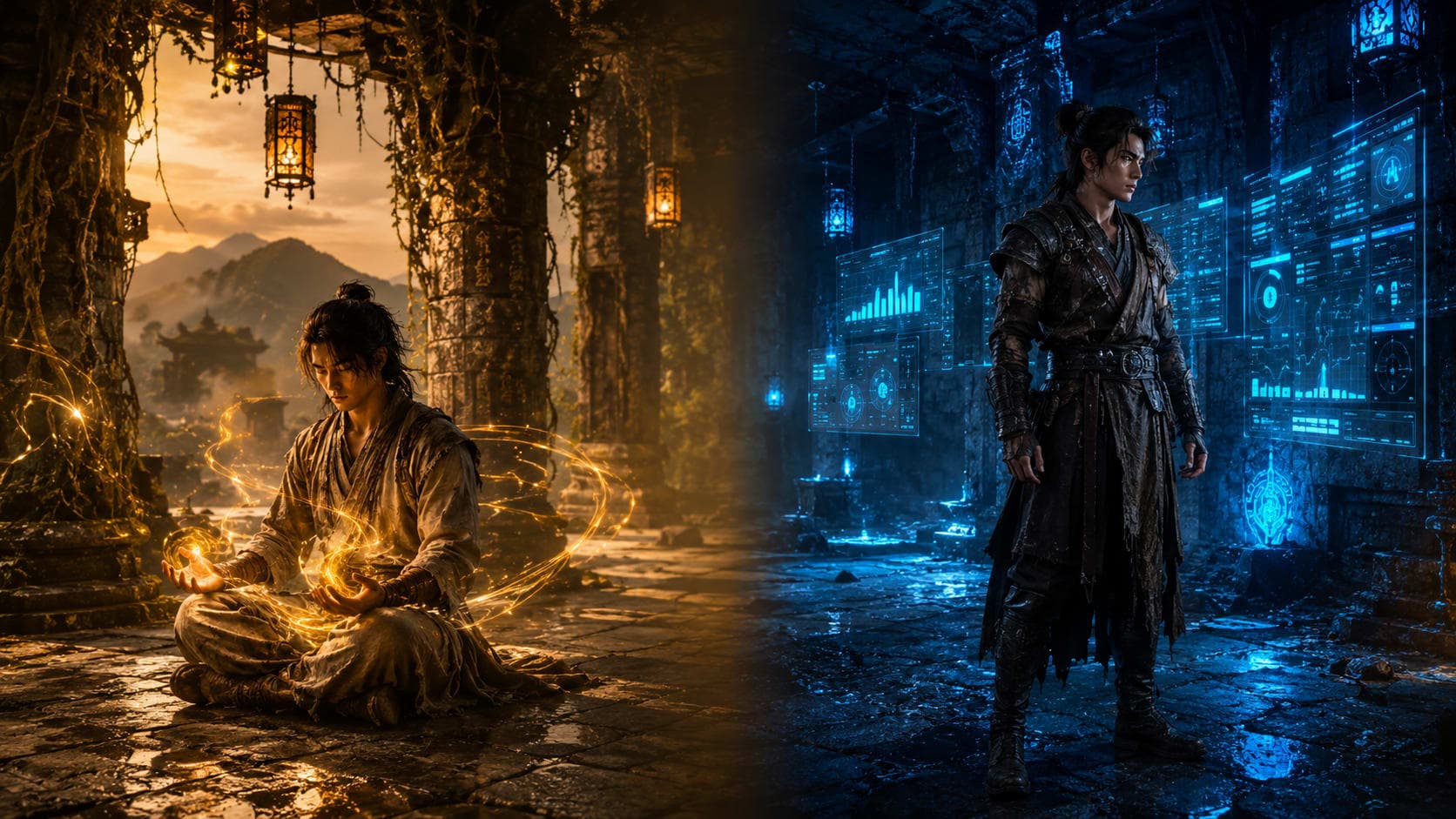
Progression Fantasy vs LitRPG: Which Niche Should You Read First?
A deep-dive guide for readers who want to understand these two explosive webnovel genres — and pick the right one.
This is not a minor semantic debate. These two labels have grown into massive, multi-million-reader corners of online fiction. Authors build entire careers inside them. Publishers treat them as separate catalogue categories. And new readers — people who just finished their first dungeon-crawl story or cultivation serial and want more — often spend more time decoding genre tags than actually reading.
So here is what this guide does. It draws a clear, honest line between the two genres. It fills in the gaps that most surface-level explainers skip over: the crunchy-vs-soft LitRPG divide, the reasons serious readers seek out stories with no game system at all, the GameLit distinction, and the strange edge case that breaks the common rule everyone quotes. By the end, you will have a concrete reading roadmap — not just a dictionary definition.
The difference between LitRPG and Progression Fantasy is not just about stat screens. It is about what the author treats as the emotional core of the story. |
What Is LitRPG Fiction?
The label LitRPG stands for Literary Role-Playing Game. The genre was born from a simple but powerful idea: what if the logic of a video game — the experience points, the skill trees, the floating character sheets — became the actual physics of a fantasy world?
In a traditional fantasy novel, a warrior trains for years and gradually becomes more powerful. The reader infers that improvement from the character's performance in battle. LitRPG makes that inference unnecessary. When a character in a LitRPG story kills a monster, a notification appears — sometimes visible only to them, sometimes announced to the sky — that tells them exactly how many experience points they earned, what new ability they unlocked, and what numerical values changed on their character sheet.
The system is not a background detail. It is the governing law of the universe, as real and non-negotiable as gravity. Characters plan around it, manipulate it, exploit loopholes in it, and ultimately rise or fall based on how well they understand it.
The Anatomy of a LitRPG System
When you open almost any LitRPG webnovel for the first time, you will encounter structural elements that have no equivalent in traditional fantasy:
- Status Screens: A complete readout of a character's numerical attributes — Strength, Agility, Intelligence, Vitality, Health Points, Mana Points, and often dozens of derived secondary stats. These screens appear in the narrative text itself, formatted like a game UI.
- Explicit Leveling: Characters earn experience points from combat, crafting, exploration, or completing quests. When they accumulate enough, they level up — and the reader sees the exact number that pushed them over the threshold.
- Codified Skills: Abilities are not vague talents. A character does not simply masters archery in blink of eye. Their 'Marksmanship' skill hits Level 7, unlocking a new passive ability and increasing their critical hit chance by a stated percentage.
- Class Systems: At certain level thresholds, characters choose between predefined character classes or evolve their existing class into a higher-tier variant. These choices have permanent mathematical consequences that the reader sees played out.
The Crunchy vs. Soft LitRPG Spectrum
Not every LitRPG handles these elements with the same intensity, and understanding this spectrum is essential before you pick your first book.
COMMUNITY TERM: Crunchy LitRPG Stories where the game system is treated like a hard, logical machine. Authors show detailed stat blocks, complex damage calculations, and precise point allocations. If a character adds five points to their Strength attribute, you will see exactly how that alters the kinetic force behind every punch they throw. Readers who love optimisation puzzles and build theory thrive here. |
COMMUNITY TERM: Soft (or Creamy) LitRPG Stories where narrative flow takes clear priority over the math. The game system still exists — characters get skill notifications, pick classes, and reference their levels — but stat blocks are brief, placed at the end of chapters rather than interrupting the action, or skipped entirely in favour of descriptive prose. These books read much closer to traditional fantasy, with just enough gamification to scratch the itch. |
Neither style is objectively better. Crunchy LitRPG rewards careful readers who want to understand exactly why a protagonist wins a fight. Soft LitRPG rewards readers who get tired of pausing the story to process a spreadsheet. Knowing which spectrum you prefer will save you a lot of abandoned reads.
What Is Progression Fantasy?
The term Progression Fantasy was put into wider use by fantasy author Andrew Rowe to describe a distinct reading experience that had existed long before anyone had a clean name for it. At its heart, Progression Fantasy is any story where the systematic, logical growth of the main character is the central event — not just a backdrop to a plot about saving the world.
The distinction sounds subtle, but it fundamentally changes how a story is structured. In a standard hero's journey, the protagonist receives power (a magical ring, a chosen-one prophecy, a mentor's blessing) and then uses it to face escalating challenges. The power is a gift. In Progression Fantasy, power is never a gift. It is a consequence — of training that hurts, of theories that take years to master, of failures that cost the protagonist something real before they break through.
That hard-won quality is what gives Progression Fantasy its emotional weight. Readers do not just watch a character win. They watch a character earn the right to win.
Power Without the Numbers
Instead, power is measured through hard, internally consistent magic systems. The reader tracks growth through what a character can now do that they could not do before — the range of their spells, the speed of their forms, the subtlety of their control. Progress is shown, not announced.
Non-System Progression: Cultivation, Xianxia, and Hard Magic Academies
A large and deeply passionate part of the Progression Fantasy readership actively seeks out stories that ditch the video game interface entirely. The reasons range from immersion preferences to outright stat-screen fatigue. These readers usually fall into one of two camps:
CULTIVATION NOVELS (Xianxia & Wuxia) Characters meditate to absorb ambient spiritual energy — called Qi in most traditions — and cycle it through their bodies to slowly purify their meridians and break through into higher realms of power. Each realm has a name rather than a number: Copper Body, Iron Skin, Gold Core, Nascent Soul. Growth is physical, spiritual, and deeply personal. Progress is verified by what the character's aura does to the air around them — not by a notification pop-up. |
HARD MAGIC ACADEMIES Characters attend institutions where magic follows strict, learnable laws. They grow by studying theory, practising dangerous spellcraft, expanding their mana capacity through controlled stress, and crafting artefacts that augment their abilities. The progression ladder is academic rank and spell complexity rather than cultivation realms or game levels. |
Both of these styles create progression that feels earned in a qualitatively different way from LitRPG — less like watching a loading bar fill, and more like watching a student slowly become a master.
As you browse platforms looking for your first series, you will run into one more label that trips up almost every new reader: GameLit.
Think of the genres as nested containers. GameLit is the largest circle — it covers any story that meaningfully incorporates video game elements. A story about a programmer trapped in a virtual reality MMORPG on a sci-fi future Earth is GameLit. A story about a woman who discovers her entire ordinary life is actually a hidden game with hidden rules is GameLit. The game element exists, but it need not generate explicit stat tracking or drive character advancement numerically.
LitRPG is a specific, stat-driven circle inside that larger GameLit space. For a story to qualify as LitRPG rather than merely GameLit, the system mechanics must actively and explicitly govern the protagonist's advancement. The numbers must mean something and the reader must see them.
The VRMMO Setting vs. the System Apocalypse Setting
Early LitRPG — particularly the wave of stories that came out of Russian and Eastern European web fiction communities in the early 2010s — was almost exclusively set inside virtual reality MMORPG games. The protagonist was always a player on Earth who entered a game world through a VR headset.
Contemporary LitRPG has almost entirely abandoned this setup. The dominant modern tropes are the System Apocalypse and Isekai Portal Fantasy:
- System Apocalypse: Earth is suddenly transformed. An alien intelligence, a godlike entity, or an unexplained cosmic event forces a game-style levelling system onto all of humanity overnight. Monsters spawn. Dungeons appear. Humans must kill, level up, and grow powerful or be consumed. The game is not a simulation — it is the new reality.
- Isekai Portal Fantasy: The protagonist dies or is transported from Earth to a fantasy world that naturally runs on game-like laws. The system is organic to that world. Locals are born with status screens. The protagonist must learn how to use the system from scratch, often with unusual starting conditions that give them an unexpected edge.
Both setups remove the VR gamer framing and ground the game mechanics as physical reality. This is why many modern LitRPG stories feel more urgent and emotionally grounded than early examples in the genre.
Now that the foundations are in place, here is a direct structural comparison. Use this as a reference when you are browsing catalogues and trying to decode a story's genre tags:
Feature | LitRPG Fiction | Pure Progression Fantasy |
|---|---|---|
Visibility of Growth | Explicit — status screens, floating notifications, menu pop-ups the character can read. | Organic — visible through combat feats, aura changes, and cultivation realm markers. |
Primary Driver | System mastery, build optimisation, stat accumulation, and skill-tier unlocks. | Deliberate training, mental breakthroughs, magical theory, and internal energy refinement. |
Visual Formatting | Text boxes in brackets [Like This], numerical charts, percentage calculations. | Traditional narrative paragraphs; descriptive magical theory; no in-world UI elements. |
Core Inspiration | MMORPGs, tabletop campaigns, dungeon crawl video games. | Martial arts epics, ancient mythology, hard magic schools, Xianxia cultivation. |
Progression Stops At | Max level is technically reachable; some stories park there deliberately. | No fixed ceiling; cultivation realms extend indefinitely into godhood or higher planes. |
Pacing Style | Rapid, gamified dopamine loops driven by level-up notifications. | Slower burn; tension builds through training investment and sudden breakthrough moments. |
The Max-Level Exception: When LitRPG Is Not Progression Fantasy
The most often repeated rule in these communities is this: all LitRPG is Progression Fantasy, but not all Progression Fantasy is LitRPG. This is true most of the time. But there is a fascinating edge case that breaks the first half of that rule.
A webnovel can be unquestionably LitRPG and contain absolutely zero progression. The game mechanics are real. The advancement is frozen. |
Picture a story about a retired dungeon boss — a maximum-level entity who has already reached the ceiling of the game system. After centuries of accumulating power, they grow bored of conquest and decide to settle down in a quiet forest village, open a bakery, and live a peaceful, overpowered existence. The world runs on explicit stat sheets, the locals interact with menus and skill trees, and the protagonist still has a status screen — it just never changes.
This is a legitimate subgenre with a real following, often described as Overpowered Slice-of-Life or Max-Level Retirement fantasy. The game mechanics are the backbone of the setting. There are no growth arcs, no breakthroughs, no training sequences. It is LitRPG. It is explicitly not Progression Fantasy.
Knowing this exception matters when you are browsing and actually want progression. A book tagged only as 'LitRPG' without a progression tag may park the protagonist at peak power from chapter one and never move that needle. Check the community reviews before you commit.
Progression Fantasy vs LitRPG: Which Niche Should You Read First?
The honest answer is that your existing media habits will tell you more than any genre definition. Use this mental checklist as a starting point. These are not hard rules — you will likely enjoy elements of both — but they will point you toward the faster, more satisfying first read.
Start with LitRPG if any of these describe you:
- You are a gamer first. If you have ever spent serious time optimising a character build in an RPG, enjoying the satisfaction of a level-up screen, or theorycrafting a dungeon strategy, LitRPG will feel immediately familiar. The narrative loop is designed to recreate exactly that dopamine hit in prose form.
- You want external validation of growth. LitRPG makes advancement unambiguous. You do not have to infer that a character has grown stronger from context clues. The system tells you. If you prefer clarity over showing over telling, this is your lane.
- You enjoy clever system manipulation. The most beloved LitRPG protagonists are not the strongest — they are the smartest. They find loopholes, break the rules of a rigid system, and defeat opponents three levels above them through creativity. If that kind of lateral problem-solving excites you, start here.
- You want fast-moving, high-stakes survival energy. System Apocalypse LitRPGs in particular are propulsive. The levelling loop creates constant forward momentum. If you bounced off slow-burn epics in the past, LitRPG's pacing structure will keep you reading late into the night.
Start with Progression Fantasy (non-system) if any of these fit:
- You come from traditional epic fantasy or shonen anime. If you grew up reading Robert Jordan or Brandon Sanderson, or watching Dragon Ball or Hunter x Hunter, you already have an intuitive feel for what Progression Fantasy delivers. The power ladder, the training arc, the breakthrough moment — these are familiar emotional beats in new settings.
- You find stat boxes immersion-breaking. Some readers cannot read past a detailed status screen without losing the thread of the narrative. If numbers in your fiction feel like homework rather than reward, pure progression and cultivation stories will serve you far better.
- You want the growth to feel spiritual or artistic. Cultivation fiction in particular frames power as something that is refined from within — a discipline as much as an ability. If you want your protagonist's growth to feel like the development of a martial art or a philosophy, not the grinding of a progress bar, this is the corner for you.
- You prefer deep worldbuilding over mechanical clarity. Non-system Progression Fantasy tends to invest more page space in the texture of its magic — the theory, the history, the competing schools of thought. If you find that fascinating rather than tedious, you will fall hard for what this side of the genre offers.
Finding a series you love is the easy part. The harder part, in the current webnovel landscape, is finding a place to read it that does not actively fight you.
The major mainstream platforms have evolved into heavily monetised environments. Locked chapters force you into expensive coin-purchase systems. Pop-up advertisements detonate across your screen at every chapter break. Registration walls appear before you have read a single paragraph. On mobile, the experience can be genuinely unusable — banners collapsing the reading area, autoplay video ads cutting into the prose, and paywalls that move every time you get close to the story's current cliffhanger.
None of this was designed with the reader in mind. It was designed to extract money from readers who are already hooked on a story and have no easy alternative.
A Cleaner Way to Read
This is the problem that Readnovax.in was built to solve. The platform operates on a single principle: the only thing between a reader and a story should be the story itself.
- No registration barriers. You do not need an account, a verified email address, or a downloaded app to open a book. The first chapter of every serial on the platform is one click away from the catalogue.
- No coin modules or paywalls. Every story on Readnovax.in is completely free to read from the opening chapter to the latest update. There are no premium tiers, no unlock fees, and no cliffhanger-chapter locks.
- No intrusive advertisements. The platform does not serve the screen-blocking, autoplay, or interstitial ads that define the experience on legacy platforms. The layout is clean, quiet, and built for reading — not for maximising ad impressions per session.
- Mobile-optimised reading experience. The site is designed from the ground up for browser reading on both desktop and mobile. Font sizes, line spacing, and contrast are calibrated for long reading sessions without eye strain.
Whether you decide to start with a crunchy System Apocalypse LitRPG or a slow-burn cultivation epic with no numbers in sight, Readnovax.in keeps the reading experience exactly where it should be: between you and the story.
Final Thoughts
Both LitRPG and Progression Fantasy have earned their enormous readerships by offering something that traditional publishing has always underdelivered: a front-row seat to the experience of getting genuinely, visibly, undeniably better at something.
LitRPG makes that experience explicit and numerical, borrowing the feedback loop that makes video games so compelling and planting it inside a narrative. Progression Fantasy makes it emotional and qualitative, trusting the reader to feel the distance between who a character was and who they have become.
Neither genre is a lesser version of the other. They serve different needs, scratch different itches, and attract readers with meaningfully different tastes. The only wrong approach is picking one without understanding what you are actually choosing.
Now you know the difference. Go find your next obsession.
Published on Readnovax.in | Free Webnovel Reading Platform | readnovax.in
Frequently Asked Questions
Can a single webnovel be both LitRPG and Progression Fantasy at the same time?
Yes — and most popular webnovels in both genres are exactly that. A story can use explicit stat screens and level-up mechanics (making it LitRPG) while also centering the narrative entirely on the protagonist's deliberate growth over time (making it Progression Fantasy). The two labels describe different dimensions of a story: one describes the presence of game mechanics, the other describes the structure of the growth arc.
What is the difference between Xianxia and Progression Fantasy?
Xianxia is a Chinese literary tradition — a genre with its own cultural history, narrative conventions, and thematic concerns rooted in Taoist philosophy and immortality mythology. Progression Fantasy is a western analytical label applied to any story where systematic power growth is the central focus, regardless of cultural origin. Xianxia stories are almost always Progression Fantasy stories. But calling a Xianxia novel 'Progression Fantasy' only captures the mechanical structure, not the cultural and philosophical context that defines the genre on its own terms.
Do I need to have played RPG video games to enjoy LitRPG?
No — but it helps. LitRPG borrows its vocabulary and emotional language from games like World of Warcraft, Dungeons & Dragons, and dungeon-crawl RPGs. Readers who have spent time with those games will recognise the shorthand immediately. Readers who have not can still enjoy LitRPG, but expect a slightly longer adjustment period as the genre's visual formatting and mechanical terminology become familiar.
Is cultivation fiction the same as Progression Fantasy?
Cultivation fiction is one style of Progression Fantasy — it fits the definition because it centres entirely on a character's systematic, effort-based growth. But Progression Fantasy is a larger label that also covers Western hard magic systems, non-cultivation power schools, time-loop mastery stories, and any other framework where deliberate, logic-driven advancement is the core narrative event. Every cultivation story is Progression Fantasy. Not every Progression Fantasy story involves cultivation.
What are the best free progression fantasy webnovels to start with?
The three strongest entry points for beginners are: Cradle by Will Wight (Western cultivation, no game system, zero-to-hero arc), Dungeon Crawler Carl by Matt Dinniman (System Apocalypse LitRPG with exceptional character writing), and Mother of Learning by Nobody103 (hard magic academy, time loop, completely free online). All three are accessible to readers with no prior experience in either genre.