ReadNovaX Blog
How to Start a Webnovel Series from Scratch — Complete Beginner's Guide
Want to write your first webnovel but don't know where to begin? This step-by-step guide covers niche selection, chapter planning, the buffer strategy, platform choice, and building readers from day one.
Published May 30, 2026

You have the idea. You have the characters sketched out, the world half-built in your head, maybe even a few opening lines written down. But every time you sit down to actually begin, something stops you — because deep down, you're not sure how serialized online fiction is supposed to work.
That uncertainty is the real problem, and it's more common than most writers admit.
Learning how to start a webnovel is not just about writing the first chapter. It's about understanding a completely different storytelling format, building a system that keeps you publishing consistently, and setting up your story in a way that earns readers early rather than hoping they find you later. This guide walks through every part of that process, in order, without the padding.
What Makes a Webnovel Different from a Regular Novel
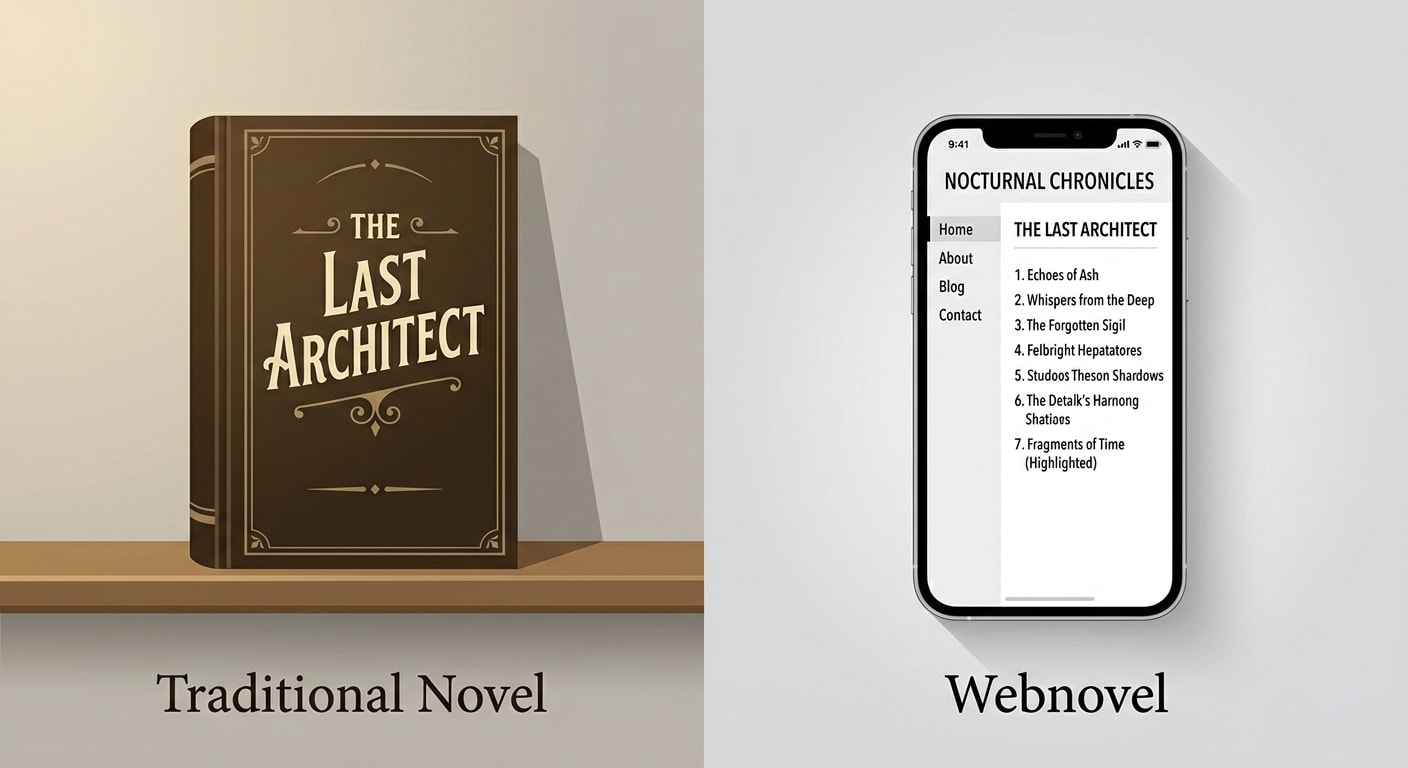
Before anything else — before your outline, your characters, your magic system — you need to settle one foundational question: how is a webnovelactually different from a book?
A traditional novel is designed as a complete, self-contained object. You buy it, read it over a few days or weeks, and the experience ends. The author wrote it in private over years, edited it with a team, and released it when it was finished. The reader has no interaction with the writer during the creation process at all.
A webnovel works on an entirely different model. You are writing and publishing simultaneously, often just a few chapters ahead of your readers. The story exists in installments — readers return for updates, often on a weekly or daily basis, the way someone follows a podcast or a TV series. The relationship between writer and reader is live, not archived.
This changes the structure of the writing itself in specific ways.
A slow first chapter in a traditional novel is acceptable — the reader has already bought the book and committed to giving it a chance. In a webnovel, a slow first chapter means the reader clicks away and never returns. You have no prior relationship with them. Their decision to keep reading happens within the first few minutes of chapter one.
Similarly, a cliffhanger in a traditional novel is a technique you use occasionally for effect. In a webnovel, every single chapter needs some version of a forward pull — a question left open, a decision not yet made, a thread the reader wants to follow into the next update. Without that pull, readers don't come back.
The writers who come from traditional fiction backgrounds and try to apply book-writing logic to a webnovel almost always run into the same problem: strong writing that doesn't hold a serialized audience. The content is good, but the pacing architecture doesn't match the format. Getting this distinction clear in your head before you write chapter one saves you from rebuilding your story from scratch around chapter 20.
Step 1: Choose a Niche Where Readers Are Already Waiting
Here is an uncomfortable truth that most writing advice skips over: an original, category-defying story is one of the hardest things to grow an audience around, especially for a first-time webnovel writer with no existing platform.
Online reading communities are built around genre and trope recognition. Readers don't browse for "something different" — they search for specific tags, familiar dynamics, and known genre conventions that they already enjoy. If your story doesn't clearly fit any recognizable category, readers won't know how to find it, and even if they do find it, they won't know whether it's for them.
Choosing a niche doesn't mean writing a generic story. It means writing within a space where readers are already active — and then doing something specific within that space that those readers feel is missing.
The webnovel niches with the strongest active readership right now:
- Progression Fantasy and LitRPG — The protagonist gains power systematically, often through a game-like interface with levels, stats, and skill trees. Readers in this niche read obsessively and follow long series. They want consistent power growth and satisfying milestone moments.
- Cozy Fantasy and Slice-of-Life — Low stakes, no world-ending threats, just a character building something meaningful — a shop, a garden, a small community. This niche is growing fast because readers are actively burned out on high-stress plots.
- Romantasy with Slow Burn — Fantasy world-building built around a central romantic arc, usually with significant tension before the relationship resolves. Readers here are some of the most loyal and community-oriented in the whole webnovel space.
Once you've picked your niche, spend two or three hours reading comment sections on popular stories within it. Skip the praise. Focus entirely on what readers complain about.
You'll find patterns quickly. Readers frustrated by the same female lead archetype appearing in every story. Readers tired of a specific plot device being recycled across dozens of series. Readers asking out loud why no one writes a version of this genre where a certain thing happens differently.
Those complaints are a direct map to what your story should do. You're not chasing trends — you're filling a specific gap that an existing, active audience has already identified and articulated for you.
Step 2: Plan at Two Levels — The Long Arc and the Chapter Loop
Planning a webnovel is different from outlining a novel, and the mistake most new writers make falls into one of two extremes.
The first extreme: no plan at all. They start strong, write with energy through the first dozen chapters, and then around chapter 20 the plot starts circling. Subplots that went nowhere. Characters introduced and forgotten. A story that feels like it's delaying its own point. Readers can feel this loss of direction and they leave.
The second extreme: over-planning. They outline every chapter, every character arc, every subplot twist before they write a word. Six weeks later, the outline is 40 pages long and they've written nothing publishable. The plan becomes a procrastination tool.
The right approach uses two specific layers of planning — no more, no less.
Layer One: Map Your Volumes
Divide your story into Volumes. Each Volume is roughly 30 to 40 chapters and functions like a single season of a TV show — it has its own complete arc, its own escalation, and its own satisfying resolution, while still setting up the next Volume.
Before you write chapter one, define one concrete milestone for each of your first two or three Volumes. Just one sentence per Volume. That sentence is the destination your story is driving toward for those 30 to 40 chapters.
Here's what that looks like in practice:
- Volume 1: The protagonist has to rescue their younger sibling from a noble house that purchased their debt — without any legal standing or money to do it through legitimate channels.
- Volume 2: Having exposed the noble house's corruption, the protagonist is now a visible threat to people with much more power, and the consequences arrive.
That's the whole plan you need at this stage. Two sentences. Two destinations. Enough to keep your plot moving with purpose across 60 to 80 chapters without locking you into a rigid structure that kills the creative flexibility you'll need when reader feedback shapes the story.
Layer Two: Build the Chapter Loop
Every individual chapter needs to follow a consistent internal structure. This isn't about formula — it's about giving your reader what they need at the chapter level to feel satisfied enough to come back.
The three-part chapter loop works like this:
Part one — Open with momentum. Your chapter begins by responding directly to the situation left at the end of the previous chapter. The reader is already oriented. You don't need to re-establish anything — you move forward immediately.
Part two — Shift the situation. Something in the chapter changes. A piece of information arrives that the protagonist didn't have before. A decision gets made. An obstacle appears from an unexpected direction. The change doesn't have to be dramatic — it just has to move something forward.
Part three — End on an open thread. Close the chapter at a moment where something is unresolved. Not a frustrating cliffhanger that feels like a trick — just a thread the reader wants to follow. A conversation that just started. A choice that hasn't been made yet. A door that just opened.
Keep chapters between 1,200 and 2,000 words. That length is long enough to deliver a complete, satisfying scene and short enough to read in under 10 minutes on a phone. A reader who finishes a chapter quickly, feels good about it, and immediately wants the next one is far more valuable than a reader who respects your craft but keeps putting the story down because each chapter is an hour-long commitment.
Step 3: Build Your Buffer Before You Publish Anything
This is the step with the highest impact on your long-term success, and it's the one most new writers skip entirely because it feels like unnecessary delay.
Here is what happens to writers who skip it: they launch with three chapters, post updates as fast as they write them, build a small excited audience — and then life intervenes. A demanding work week. An illness. A family obligation. They miss one upload. Their notification stream goes quiet. Readers who were engaged start checking other stories. By the time the writer recovers and posts again, the momentum is broken and rebuilding it takes weeks.
The buffer strategy makes this scenario impossible.
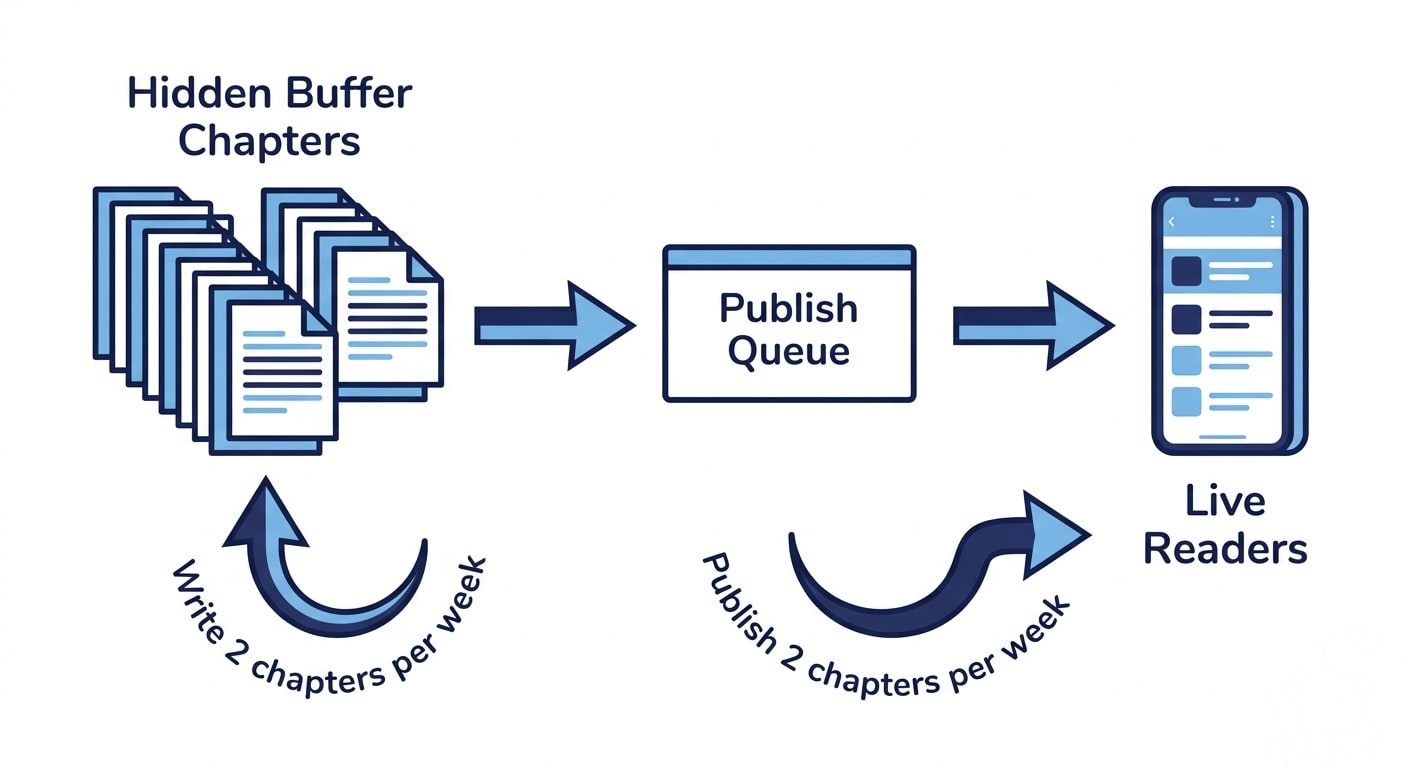
Before you publish chapter one, write and fully polish at least 8 to 12 chapters and keep them hidden. Don't publish them yet — they are your reserve. When you do launch, you're not releasing what you just wrote. You're releasing from the front of a queue you built in advance.
The operating rhythm looks like this:
You publish two chapters per week from your buffer. You write two new chapters per week to replace them. Your buffer stays roughly the same size week after week. If a bad week comes and you write nothing at all, your published schedule continues unaffected. Your readers see consistency. The platform's algorithm sees an active, reliable story. You have a week to recover without any visible damage to your series.
There's a second advantage that writers don't anticipate until they experience it: the buffer gives you editing distance. Chapters you write today and publish next week are chapters you can revise after reading them with fresh eyes. You'll catch awkward dialogue, pacing issues, and plot inconsistencies in your buffer that you would have published immediately if you had no reserve. The quality of what goes live is meaningfully better when you have that gap between writing and publishing.
A third advantage: by the time your buffer chapters go live, you may have early reader comments that change what you want to do with them. A detail readers responded to strongly in chapter two might be worth reinforcing in chapter eight. A character readers are more interested in than you expected might deserve more page time in chapter eleven. The buffer gives you the flexibility to act on that feedback before the chapters publish rather than after.
Step 4: Pick a Platform That Works for New Writers
Where you publish shapes how fast you grow, especially in the early stages when you have no existing audience to bring with you.
The most well-known option is large aggregator platforms — the major corporate sites that already have millions of registered readers. The appeal is obvious: the audience is there. But for a new story with no track record, the reality of these platforms is more complicated.
Most large aggregators use algorithmic discovery systems that heavily favor stories that already have engagement — high read counts, reviews, followers, and ranking history. A new story entering that environment competes directly against established series with years of accumulated visibility. Even strong writing doesn't overcome algorithmic disadvantage when the system is designed to surface proven performers over newcomers.
Beyond discovery, many large platforms have moved aggressively toward monetization models that lock content behind paywalls after a small number of free chapters. For a writer without a pre-existing audience, this creates an immediate problem: casual readers who find your story through social media won't create an account and enter payment details for a story they haven't read enough of to trust yet. A paywall in the early chapters of an unproven story is a wall between you and your potential audience.
There's also the question of ownership. Some major platforms include clauses in their terms of service that affect your rights to publish the same content elsewhere. Reading those terms carefully before you sign up matters, especially if you intend to eventually publish the story in other formats.
Open, free-to-read platforms without mandatory registration remove the single biggest source of early friction. When a reader finds your story mentioned in a Reddit thread, a BookTok video, or a Discord server and clicks the link, they land on the chapter text with nothing in the way. No account creation. No payment prompt. No ad wall they have to wait through. They just read.
That frictionless access turns your social sharing into actual readership. Every person who clicks the link becomes a potential regular reader. On a platform with barriers, a significant portion of those same clicks produce nothing because the reader hits the first obstacle and moves on.
The practical path for a new writer: Start on an open, accessible platform. Build your readership, your review count, and your community there. If you later want to expand to larger aggregators, you'll have social proof to bring with you — an established series, reader comments, follower numbers — and you'll enter those platforms in a far stronger position than a blank-slate new story.
Step 5: Write a First Chapter That Earns the Next Click

The only job your first chapter has is to make the reader open chapter two. That's it. Not establish your world. Not introduce your full cast. Not explain your magic system. Just make them want to read what comes next.
Understanding what breaks that goal is as important as understanding what achieves it.
What consistently kills retention in chapter one:
Opening with world history, a map description, or a prophecy sets up the writer's interests, not the reader's. Readers don't care about history yet — they care about people in situations. The history can come later, delivered through a character who is actively living in that world.
Starting the story before anything interesting is happening — your protagonist waking up, commuting, or having breakfast — signals to the reader that the story hasn't started yet. They'll wait one chapter for the story to begin, but only one.
Dream sequences and "it was all a dream" openings are recognized immediately. Readers know the technique, and it signals that the writer didn't trust their real story enough to start with it.
What earns the second read:
Drop your reader into a moment already in progress. The character is doing something, reacting to something, or making a decision. The reader doesn't need complete context — they need enough to feel oriented and enough mystery to want more.
Give the protagonist something specific they want or something specific they're afraid of within the first few paragraphs. It doesn't have to be the central conflict of the whole story. It just has to be real and immediate. A reader who has someone to root for will stay to see what happens.
Make sure something changes before the chapter ends. The situation at the close of chapter one should be different from the situation at the opening. Movement matters. If a reader reaches the end of your first chapter and the character is in the exact same position they started in, there's no reason to open chapter two.
End at the moment of commitment — right when your protagonist has decided to do something or has just learned something that changes everything. Leave that thread open. The reader's brain, encountering an unresolved situation it cares about, will want resolution. That want is the click to chapter two.
Step 6: Set a Publishing Schedule You Can Keep for a Year
Frequency matters less than reliability. A writer who publishes two chapters per week without missing a single deadline for six months builds a more loyal, more consistent readership than a writer who publishes five chapters one week, disappears for two weeks, publishes three more, then goes silent again.
Readers who can't predict when your updates arrive eventually stop checking. Readers who know that you publish every Tuesday and Friday at a specific time build that check into their week. It becomes a habit. Habits are extraordinarily hard to displace once formed.
Pick two specific days per week. The same days every week, permanently. Early in your series, announce those days in your author notes so readers know what to expect.
Matching your schedule to your actual life:
Two chapters per week is the standard starting point for writers who have full-time work or school alongside their writing. It's achievable with consistent daily writing sessions of 30 to 45 minutes, and with a buffer in place, a bad week doesn't show.
Three chapters per week works if writing is your main daily focus or if your chapters run shorter. It builds momentum faster and keeps algorithmic indicators more active, but it's a meaningful time commitment that needs to fit genuinely around your life, not theoretically.
One chapter per week is a valid option, but it asks more of each individual chapter. At this pace, each update needs to deliver more narrative progress and more emotional payoff per installment to keep readers satisfied between releases. It works best for writers whose chapters run longer — 2,500 to 3,500 words — and who prioritize craft over speed.
Choose the schedule that feels slightly easy given your current life, not the one that feels ambitious. The schedule that challenges you on a good week will break you on a hard one. The schedule that feels comfortable on a hard week is the one you'll still be running six months from now.
Common Mistakes That End Promising Webnovel Series
Building the world before building the story
The instinct to design an intricate world before writing a single chapter is understandable. But when that world-building reaches the page as explanation — paragraphs describing the political history, the geographic layout, the five schools of magic — before the reader has any emotional investment in the story, it reads as a delay. Start with the character in motion inside the world. The reader will absorb the world's details naturally through the character's experience of it.
Trying to introduce everyone early
New writers often feel pressure to establish the full cast within the first few chapters so readers "know who everyone is." What actually happens is that a reader encountering seven named characters in chapter two doesn't retain any of them clearly. One protagonist, one setting, one conflict. Secondary characters earn page time by earning the reader's attention first, which happens through the main character's relationship with them, not through early introductions.
Ignoring what your readers are telling you
Traditional publishing isolates the writer from the reader until after the book exists. Webnovel publishing reverses that entirely. Your comment section is a live signal. When the same concern appears across multiple reader comments — a character behavior that feels off, a plot point that doesn't track, a chapter that felt slow — that's reliable information. You don't have to rewrite your vision based on every opinion, but recurring patterns across many readers almost always point to something structural. The buffer gives you the chance to address it before affected chapters go live.
Chasing the perfect draft before publishing
Some writers revise their first three chapters for months without publishing them. In traditional publishing, that approach makes sense. In webnovel culture, it's counterproductive. Your writing improves faster from reader feedback than from private revision. A story that is 80% polished and live will grow, generate responses, and teach you more about your own writing than a story that is 95% polished and still sitting in a private document. The feedback loop that makes webnovel writers improve quickly only starts once the work is public.
Pre-Launch Checklist: What You Need Ready Before Chapter One Goes Live
Work through every item here before publishing:
- Niche confirmed — You know your core genre, your sub-genre, and you have 3 to 5 specific tags that describe your story accurately
- Volume 1 milestone written — One sentence describing what your story achieves by chapter 30
- Buffer complete — At least 8 fully polished chapters written, edited, and kept in reserve
- Platform selected — A platform where readers can access your chapters without sign-up requirements or paywalls like ReadnovaX.in
- Release days set — Two specific days per week chosen and locked, with a plan for announcing them to early readers
- Chapter 1 reviewed against retention criteria — If it opens with history, geography, or a dream, revise the opening before publishing
- Author notes prepared — A short, warm introduction for your first chapter that tells readers your release schedule and invites them to comment
Closing Thought

A webnovel series that lasts is built on structure, not inspiration. Inspiration gets you through the first few chapters. Structure — a planned arc, a filled buffer, a consistent schedule, a platform your readers can access without friction — is what gets you to chapter 50, and then to chapter 100.
The writers who build large, loyal audiences over time are not always the most naturally talented people on the platform. They're the ones who treated the craft as a system, respected their readers' time and expectations, and kept showing up on schedule even when the excitement of a new project faded.
Get your niche right. Plan your volumes. Build your buffer before you publish. Write a first chapter that earns the second read. Set a schedule that fits your actual life. That combination, applied consistently, is how a webnovel series grows.
The first chapter is the only one that matters right now. Write it.
Enjoyed this guide? Our next piece covers building an active reader community around your webnovel — including how to use author notes, reader polls, and advance chapter access to turn casual readers into committed followers from volume one.read hear
Frequently Asked Questions
How many chapters should I write before starting a webnovel?
Write at least 8 to 12 chapters before publishing anything. This gives you a buffer that protects your publishing schedule when life gets in the way — and it will. Don't launch with just three chapters because you're excited. Build the reserve first.
What is a good length for a webnovel chapter?
For most webnovel niches, 1,200 to 2,000 words per chapter is the ideal range. It's long enough to deliver a complete, satisfying scene and short enough to read comfortably on a phone in one sitting. Some writers go longer in specific genres, but under 1,000 words per chapter often feels too short to be satisfying.
How often should I update my webnovel?
Two chapters per week is the standard starting point and works for most writers with other commitments. More important than the number is the consistency — the same days, every week, without missing. Readers form habits around predictable schedules.
Do I need to finish my webnovel before publishing?
No — most webnovels are written and published simultaneously. You typically stay 8 to 12 chapters ahead of your readers through your buffer. Some writers plan the full story arc before starting; others work from volume-level milestones and discover the details as they write. Both approaches work.