ReadNovaX Blog
How Long Should a Webnovel Chapter Be? The Serialized Pacing Formula
Discover the ideal webnovel chapter length. Learn chapter pacing, reader retention strategies, cliffhanger techniques, and how to maintain a consistent release schedule without burnout.
Published June 19, 2026

How Long Should a Webnovel Chapter Be?
The Serialized Pacing Formula
How Long Should a Webnovel Chapter Be?
If you are writing a web novel, one question will eventually come up:
How long should a webnovel chapter be?
The short answer is simple.
✦ The Ideal Range |
For most web novels, the ideal chapter length is 1,200 to 1,800 words. |
This range gives readers enough story progression to feel satisfied while remaining easy to consume on mobile devices. It also helps authors maintain a consistent publishing schedule without becoming overwhelmed. |
However, chapter length is about much more than word count.
A chapter that is 1,500 words long can feel exciting and addictive, while another chapter of the same length can feel slow and forgettable.
The real goal is not writing longer chapters.
The real goal is creating chapters that readers finish and immediately want more of.
In This Guide, You Will Learn
- The ideal webnovel chapter length
- Why reader behavior matters more than traditional writing rules
- How successful serialized fiction uses pacing
- How to structure every chapter for retention
- How to build a release schedule that prevents burnout
- The Shield Method for maintaining consistency
Whether you're writing fantasy, romance, LitRPG, progression fantasy, sci-fi, or slice-of-life fiction, these principles will help you create a stronger reading experience.
Many new writers make the mistake of treating web novels like traditional books.
Traditional novels are usually written, edited, revised, and published as complete works. Readers consume them at their own pace.
Web novels operate differently.
Key Differences: Webnovel vs Traditional Publishing |
→ Web novels are serialized — readers consume chapters one at a time. |
→ Every chapter becomes a mini experience. |
→ Every update becomes an event. |
→ Focus is on momentum, not chapter size. |
→ Readers return because the story keeps moving. |
In a traditional novel, a chapter might be 4,000 to 6,000 words. In serialized fiction, that same length can create problems:
- Reader fatigue
- Lower completion rates
- Reduced binge reading
- Difficult publishing schedules
Successful web fiction focuses on momentum rather than chapter size. Readers return because the story keeps moving.
Featured Snippet Answer
❓ How many words should a webnovel chapter be? |
The ideal webnovel chapter length is 1,200 to 1,800 words. This range provides enough space for meaningful story progression, character development, and a compelling chapter ending while remaining comfortable for mobile readers. It also allows authors to maintain a consistent publishing schedule without sacrificing quality. |
For most genres and platforms, this range represents the sweet spot between reader satisfaction and long-term sustainability. |

Why 1,200–1,800 Words Works So Well
The popularity of this range is not random. It aligns with how people actually consume online fiction. Most web novel readers access stories through smartphones.
Readers Typically Open Web Novels During:
- Morning commutes
- Lunch breaks
- Waiting periods
- Study breaks
- Evening relaxation
A chapter of roughly 1,500 words can usually be completed in 5–10 minutes. That makes it easy to fit into everyday life. More importantly, it creates a satisfying reading experience without overwhelming the reader.
When readers finish a chapter quickly and enjoy it, they are more likely to continue. This creates the powerful binge-reading effect that drives successful web novels.
Reader Retention and the Psychology of Chapter Length
When chapters become excessively long, readers often postpone reading them. When chapters are too short, readers may feel unsatisfied.
⚖ The Balance Goal |
The 1,200–1,800 word range allows authors to introduce conflict, develop a scene, deliver meaningful progression, and end with curiosity — all within a single reading session. |
Can a Chapter Be Too Short?
Yes. Short chapters are not automatically bad. However, chapters under 800 words often struggle to provide meaningful progression. Readers may feel that nothing important happened.
Common Problems with Very Short Chapters
- Weak character development
- Limited emotional impact
- Unsatisfying story progression
- Frequent filler chapters
- Reduced immersion
Is 500 Words Too Short for a Webnovel Chapter?
💡 Short Chapter Guidance |
A 500-word chapter can work occasionally for dramatic moments or special scenes. However, using extremely short chapters consistently may leave readers feeling unsatisfied and can reduce long-term engagement. |
Short chapters should be a storytelling choice, not a writing habit. |
Can a Chapter Be Too Long?
Absolutely. Many new authors believe longer chapters automatically provide more value. In reality, very long chapters can create new problems.
Common Problems with Long Chapters
- Mobile screen fatigue
- Lower completion rates
- Slower release schedules
- Increased editing workload
- Reduced binge-reading momentum
Is 3,000 Words Too Long for a Webnovel Chapter?
Not necessarily. A 3,000-word chapter can work if the pacing remains strong and every scene serves a purpose. However, if most chapters exceed 3,000 words, readers may begin delaying updates because they require more time to finish.
📌 Key Insight |
Consistency often matters more than size. |
This table reflects common reader behavior across serialized fiction platforms.
Chapter Length | Reader Experience |
|---|---|
Under 800 Words | Often feels too short |
800–1,200 Words | Acceptable but limited |
1,200–1,800 Words | ✦ Ideal range |
1,800–2,500 Words | Good for some genres |
3,000+ Words | Higher fatigue risk |
Different genres have different pacing needs.
Genre | Recommended Length | Reason |
|---|---|---|
Romance | 1,200–1,600 words | Emotional progression over action |
Fantasy | 1,500–2,200 words | Worldbuilding needs more space |
LitRPG | 1,600–2,500 words | Game systems & stat content |
Progression Fantasy | 1,500–2,500 words | Training arcs & advancement |
Slice of Life | 1,000–1,500 words | Smaller daily event structure |
Romance
Recommended: 1,200–1,600 words. Romance readers often prioritize emotional progression and character interaction over large action sequences.
Fantasy
Recommended: 1,500–2,200 words. Fantasy stories typically require more worldbuilding and scene development.
LitRPG
Recommended: 1,600–2,500 words. Game systems, progression mechanics, and stat-related content often require additional space.
Progression Fantasy
Recommended: 1,500–2,500 words. Training arcs and advancement systems benefit from slightly longer chapters.
Slice of Life
Recommended: 1,000–1,500 words. Smaller daily events work well with shorter chapter structures.
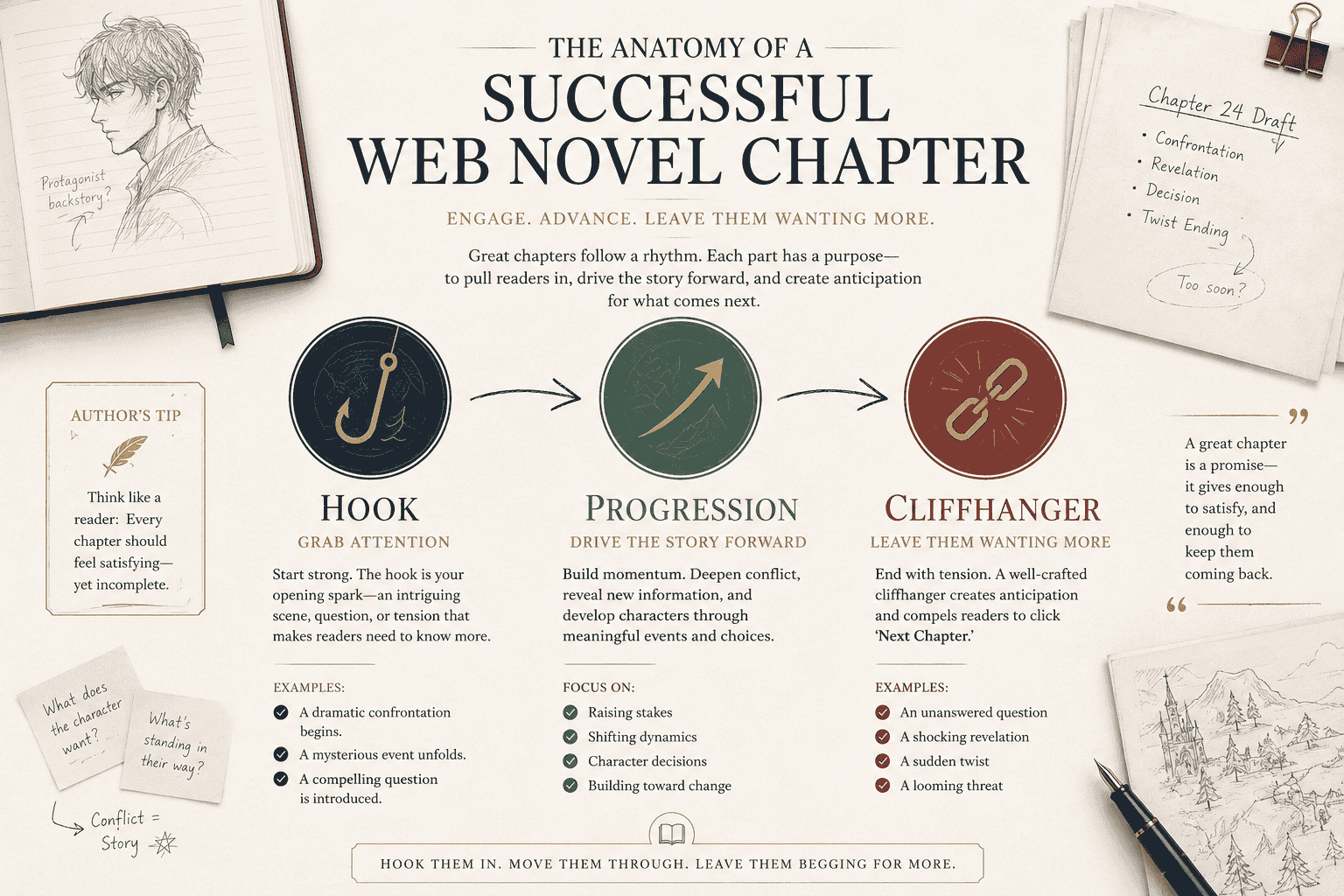
Part 1: The Hook — First 200 Words
The beginning should immediately pull readers into the story.
- Avoid lengthy recaps
- Avoid excessive description
- Focus on action, dialogue, conflict, or consequences
Simple Hook Formula
Part 2: Progression — Middle Section
Progression Examples
📖 Key Principle |
Progression is what separates meaningful chapters from filler. |
Part 3: The Cliffhanger Loop — Final 200 Words
Great web novels create curiosity. Poor web novels simply stop. A good cliffhanger creates a question that readers want answered.
Cliffhanger Types
- A shocking revelation
- An unexpected visitor
- A dangerous choice
- A hidden truth
- A major consequence
Why Cliffhangers Matter |
Curiosity drives chapter clicks. |
Chapter clicks drive retention. |
One of the biggest mistakes new authors make is focusing entirely on plot. Successful serialized fiction focuses on pacing.
Section | Weight | Purpose |
|---|---|---|
Hook | 20% | Grab attention immediately |
Progression | 60% | Move the story forward |
Cliffhanger | 20% | Create anticipation for next chapter |
This structure works because it mirrors how readers naturally consume episodic content.
Many authors attempt to plan an entire 500,000-word story before publishing. This usually leads to burnout. Instead, think in smaller story blocks.
Use Volume-Based Planning
Rather than outlining everything, focus on:
This approach provides flexibility while maintaining direction.
Keep Paragraphs Short
Large walls of text are difficult to read on mobile devices. Aim for:
- 2–4 sentence paragraphs
- Frequent dialogue breaks
- Clear visual spacing
Prioritize Scene Momentum
Every scene should accomplish at least one objective:

One of the biggest reasons web novels fail is inconsistent publishing. Life happens. Work gets busy. Motivation disappears. Unexpected events occur.
Without preparation, authors miss updates. Readers lose confidence. Growth slows.
What Is the Shield Method?
The Shield Method is a simple publishing system.
Step | Action |
|---|---|
Step 1 | Write 10 complete chapters before publishing |
Step 2 | Launch with your first chapter |
Step 3 | Continue writing while readers consume your backlog |
Step 4 | Always maintain a buffer of at least 8–10 chapters |
🛡 Why It Works |
This buffer protects your schedule from real-world disruptions. |
Think of it as an insurance policy for your web novel. |
Consistency builds reader trust. Readers develop habits. When updates appear on predictable days, readers return automatically.
Recommended Publishing Schedules
Schedule | Days |
|---|---|
Option A | Tuesday + Friday |
Option B | Monday + Thursday |
Option C | Wednesday + Saturday |
The specific days matter less than consistency. Two reliable releases per week usually outperform random publishing bursts.
🔁 Core Principle |
Predictability creates reader loyalty. |

After developing your chapter structure and release strategy, the next step is choosing the right platform.
Many traditional web fiction platforms rely heavily on paywalls, complicated monetization systems, or visibility barriers that make it difficult for new writers to gain attention. Modern readers increasingly prefer a smoother experience.
Readnovax Focuses On What Matters Most
- Story discovery
- Reader engagement
- Accessible publishing
- Mobile-friendly reading
- Direct connection between authors and readers
For independent writers, this creates an environment where storytelling remains the primary focus. If you've already built your chapter buffer and planned your release schedule, you're ready to start publishing and growing your audience.
Final Thoughts
Successful web novels are rarely built by authors who write the longest chapters.
They are built by authors who consistently deliver satisfying chapters.
✦ The Four Foundations of a Successful Webnovel |
1. Focus on progression rather than word count. |
2. Build a chapter buffer before launch. |
3. Maintain a predictable publishing schedule. |
4. Create endings that inspire curiosity. |
The Ideal Range |
For most writers, the ideal range remains 1,200 to 1,800 words because it balances reader retention, pacing, mobile consumption, and long-term sustainability. |
Do these things consistently, and your web novel will have a much stronger chance of attracting readers, retaining them, and growing into a long-term series. |
readnovax.in
The Serialized Pacing Formula • 2026 Edition
Frequently Asked Questions
What is the best chapter length for mobile readers?
Most mobile readers prefer chapters between 1,200 and 1,800 words because they can usually be completed in a single reading session without causing fatigue.
How often should webnovel authors publish?
For most authors, two consistent updates per week provide a strong balance between reader engagement and sustainable writing habits.
Does genre affect chapter length?
Yes. Romance often benefits from shorter chapters, while fantasy and LitRPG stories frequently support longer chapter lengths due to additional worldbuilding and progression systems.
Should every chapter end with a cliffhanger?
Not every chapter needs a dramatic cliffhanger, but most chapters should create curiosity that encourages readers to continue.
Is consistency more important than chapter length?
In most cases, yes. Readers generally prefer reliable updates over unpredictable publishing schedules.